

Execution is a system problem, and it's breaking your business.
Most companies don't fail at creating strategy. They fail at operationalizing it. Sales has CRM. Finance has FP&A. Operations has ERP. But strategy still runs on slides and spreadsheets, and the results speak for themselves.
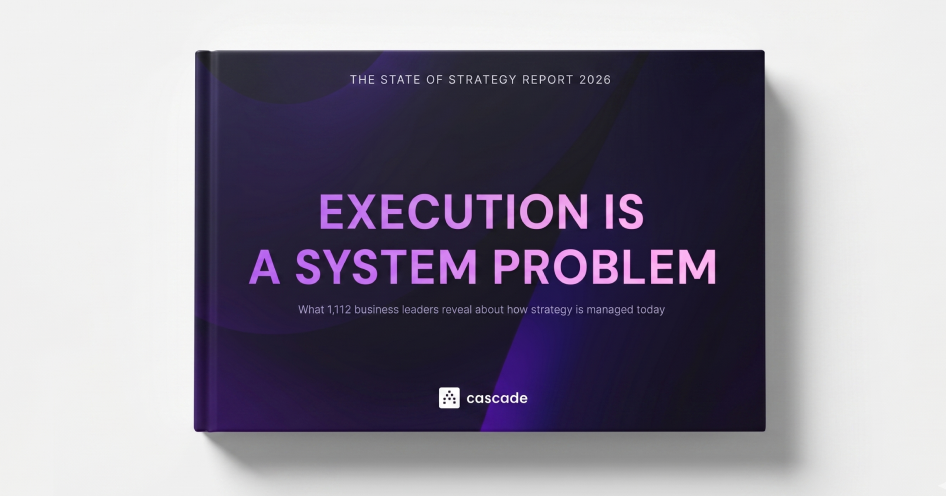
This free report reveals why strategies that look good in the boardroom die in the business—drawn from a global survey of 1,112 business leaders, analysis across industries and company sizes, and over a decade of experience helping organizations institutionalize strategy.
Here's what the data says about the state of strategy today:
Get the data, frameworks, and insights to finally close the gap between strategy and execution.
✅ Understand why the execution gap is structural, not behavioral
✅ Learn the four structural shifts that turn strategy into a system-enabled disciplin
✅ Discover why AI accelerates whatever infrastructure it sits on—for better or worse
✅ Benchmark your organization against 1,112 companies worldwide
✅ Get a clear framework for Strategy-Led Performance (SLP) and how to implement it
This isn't just a report, it's a diagnosis of why strategy stalls, and a practical guide to making it run like every other critical business function.
Inside, you'll find the case for treating strategy as infrastructure, not a document. You'll see how leading organizations embed strategy into live operational data, governance rhythms, and accountability systems so priorities don't drift, meetings don't stall, and capital doesn't get wasted on initiatives nobody agreed on.
Why You’ll Love This Report
Built on insights from 1,112 business leaders worldwide across LATAM, APAC, North America, and EMEA.
You'll get a clear diagnosis of why strategy breaks down, not at the planning stage, but at the infrastructure layer where execution actually happens.
Learn why the competitive divide is no longer AI adoption, it's infrastructure maturity. Discover what separates organizations where AI guides decisions from those where it just summarizes documents.
Use the four structural shifts to turn strategy from a quarterly presentation into a continuous operating discipline and assess your strategy with a free maturity assessment.




%201%20(1).svg)

.svg)


