


TL;DR:
→ The best strategy execution software in 2026 is Cascade for organizations managing complex, multi-team strategies across multiple frameworks.
→ ClearPoint Strategy is the strongest option for reporting-heavy teams in government and healthcare.
→ AchieveIt works best where adoption across non-technical users is the hardest problem.
→ Wrike and Hive suit teams that primarily need project management with light OKR support.
The real question isn't which platform has the most features. It's which one closes the gap between the plan your leadership team built and the work your people actually do every day.
Harvard Business Review estimates that 67% of well-formulated strategies fail due to poor execution. The flip side: a PwC/Strategy& study found that companies serious about strategy execution are three times more likely to report above-average growth and twice as likely to report above-average profits.
Our own 2025 Strategy Report surveyed 459 business leaders and found that only 3.55% of companies ever reach true execution maturity and 80% of teams aren't aligned on what actually matters.
Strategy isn't broken, execution is.
The 10 Best Strategy Software Platforms in 2026
1. Cascade: Best for End-to-End Strategy Execution
.avif)
Cascade is a Strategy-Led Performance platform (also referred to as a strategy execution platform) built for organizations that need to plan, execute, and track strategy across multiple teams and frameworks in one place. Unlike every other tool on this list, it covers the full strategy lifecycle, from setting the plan to real-time execution tracking and reporting, without forcing you into a single methodology. You can run OKRs, Balanced Scorecard, Hoshin Kanri, and PPM simultaneously.
Tapestry AI, Cascade’s intelligence engine, flags where execution is drifting and pushes executive briefings to inboxes automatically. Tapestry captures quantitative data via integrations and qualitative context from meetings, emails, and documents to give leaders the full picture, tell them where to focus and what to do next.
Key Features
- Strategy Planner with support for OKRs, Balanced Scorecard, Hoshin Kanri, PPM, and custom frameworks
- Alignment Map showing how every team's plan and objectives connect to the overall strategy
- Metrics Library connecting live business data to strategic objectives
- Reports with drag and drop widgets, and AI-powered executive summaries that capture what’s happening in the organization
- Strategy Cadences you can configure to match your governance cycle with automated update requests
- Tapestry AI for real-time execution intelligence, risk detection, and executive briefings
- 1,000+ integrations including Jira, Salesforce, Slack, and Microsoft Teams
Pros
- AI-powered strategic insights with the Tapestry AI engine
- Single view of all initiatives and projects across the organization, with status and progress toward strategic goals in one place
- Links KPIs directly to strategic objectives with real-time tracking
- Automated goal tracking measures progress against timelines
- Intuitive interface with fast adoption curve
- In-app updates and notifications when the strategic plan changes
- Strong AI-powered reporting functionality. Reports can be shared directly with external stakeholders
- Dedicated customer support on all plans; enterprise includes a dedicated Strategy Execution Director
Cons
- The free trial is only 14 days (Update: Cascade is now available for free FOREVER for smaller teams with up to 4 users)
- Currently, support for multilingual options is limited, as all videos, guides, and webinars are available only in English.
- It’s quite comprehensive so it’s not ideal for small teams only looking for a task tracking or project tracking tool
Reviews
4.8 stars out of 5 on G2 (based on 240 reviews), leader in the segment
Pricing
Cascade has a free forever plan that supports smaller teams. For enterprise solutions, contact the Cascade Sales Team!
👉🏻 Check out more details on the pricing page

Here’s what customers say about Cascade:
“Cascade has given my company a single source of truth when it comes to our goals and what specific actions the business is taking to get there.” - G2.
“Creating a centralized space where strategic alignment can be visualized, tracked, reported against is a huge benefit. This tool helps people from all levels of the organization see how they are contributing to the vision of the company.” - G2.
“Cascade is an easy to use, very customizable, dynamic platform for strategy planning and execution. It makes strategy meaningful to all those who are using it. I really like the transparency that Cascade affords, and it has made a huge difference to how we hold people accountable to deliver on their goals.” - Kirstin H.
If you need a full software suite to handle your business strategy, we'd love to help set you up for success! Contact our sales team when you're ready 😊
2. WorkBoard: Best for Enterprise OKR Execution
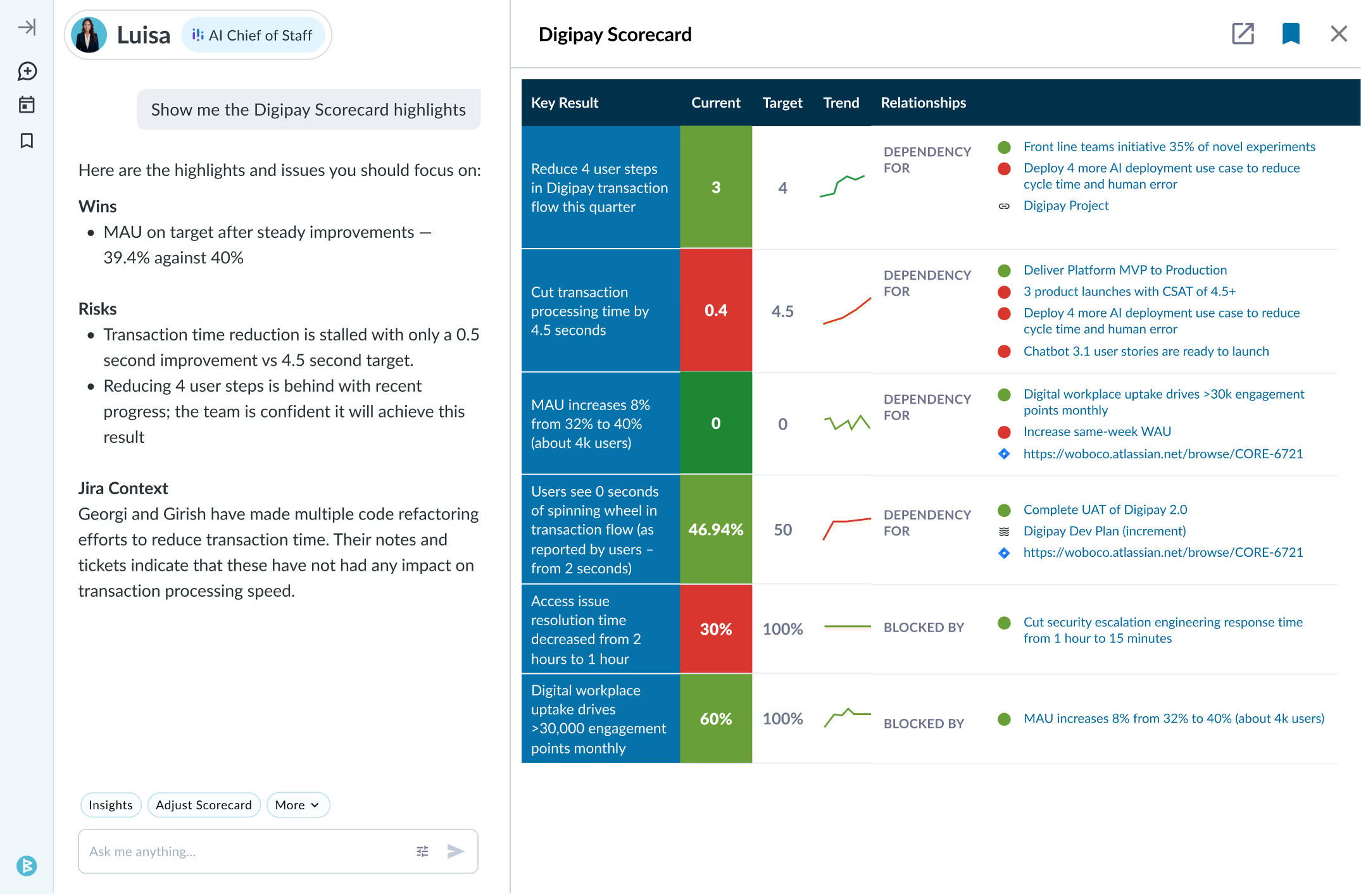
WorkBoard is an enterprise strategy execution platform built for large, complex organizations that run OKRs at scale. Its AI agents (Chief of Staff Agent and Leadership Coach Agent) generate executive briefings, flag risks before they escalate, and coach leaders on execution. The tradeoff is everything that comes with that enterprise depth: complex rollout, high cost, an OKR-only methodology, and an interface that users consistently describe as slow and difficult.
Key features:
- AI agents for executive briefings, risk flagging, and leadership coaching
- Organizational heatmaps showing OKR progress across departments
- Automated Monthly and Quarterly Business Reviews
- Multi-year strategy linked to quarterly OKRs
- Integrations with Microsoft Teams, Jira, Salesforce, and Slack
Pros
- AI coaching and performance insights
- Clean OKR cascading from executive to individual level
- Solid integrations with Microsoft Teams, Jira, and Salesforce
- Strong cross-functional alignment visibility
Cons
- OKR-only methodology, no support for other frameworks or custom
- Interface is slow and difficult to navigate (top complaint on G2 and Capterra)
- Complex rollout typically requires a 3–6 month implementation with dedicated support
- Strategy alignment not fully integrated with OKR functionality
Reviews
4.7 stars out of 5 on G2 (based on 103 reviews)
Pricing
No free plan. You have to contact sales since they don’t disclose pricing (no pricing page in their website)
3. ClearPoint Strategy: Best for Local Government and Public Sector

ClearPoint is a strategy reporting software that simplifies strategic planning and execution. ClearPoint works well for CEOs running strategy execution with a small team, particularly in local government and public sector organizations. It's built around the Balanced Scorecard and OKR frameworks and does automated reporting well. Recently added AI-assisted trend analysis helps teams surface performance insights without manual data work.
Key features:
- Automated report and dashboard generation
- Balanced Scorecard and OKR framework support
- AI-assisted trend analysis and performance recommendations
- Integrations with Excel, Power BI, Tableau, and Oracle
- Scorecards, measures, and action item management in one place
Pros
- Flexible platform with different layouts and format options to cater to the needs of each business
- A centralized view gives everyone clarity on projects
- Strong data integration with enterprise BI tools
Cons
- Supports team-level plans only, not corporate or functional plans
- No native metric integrations for common data sources
- Designed to keep strategy separate from broader business operations
- Limited framework flexibility beyond Balanced Scorecard and OKRs
- Users experienced a steep learning curve and challenging setup.
Reviews
4.6 stars out of 5 on G2 (based on 177 reviews)
👉🏻 Compare Clearpoint to Cascade
Pricing
No free plan or trial. You'd need to consult with their team since there's no pricing is available on the website.
4. MPOWR Envision: Best for Small to Mid-Size Organizations
.avif)
MPOWR Envision is a strategy execution platform built to help organizations improve communication, transparency, and team alignment. With key features like data visualization tools and simplified reporting, companies can get more value from their data, eliminate silos, and drive effective work.
It’s straightforward and effective if siloed communication is your main problem. Not if you need to connect goals to KPIs, that's a hard limitation.
Key features
- Dynamic KPI tracking with calculations
- Strategy Health Map, auto-generated color-coded overview of plan health
- Personal dashboard for each user with activity feed and goal summaries
- Comprehensive integrations including Slack, Microsoft Teams, Salesforce, and Google Docs
Pros
- Methodology-agnostic, adapts to any strategy framework
- Good customer support including intensive onboarding
- Real-time reports and summary emails to keep everyone informed on the progress of projects.
Cons
- Reporting is limited to a plan export and a moderately configurable dashboard, nothing custom
- Very limited alignment visualization, plans exist largely as standalone entities
- Appeals more to classic, compliance-oriented strategy approaches than agile organizations
- Parent company MPOWR has shifted focus toward coworking spaces. The software remains active but long-term product investment is unclear
Reviews
4.6 stars out of 5 on G2 (based on 64 reviews)
Pricing
Envision has no free plan. The paid plans start at $500/month (for 25 users minimum)
5. Hive: Best for Hybrid Team Project Management

Hive is a project management platform—similar to Clickup or Asana—that allows hybrid teams to collaborate on projects & tasks through simplifying workflows and approvals, and helping define objectives, set milestones, and assign tasks. It also has a native AI assistant called Buzz that automates routine work and answers questions using your actual workspace data. It's most popular with marketing, IT, and creative teams that need flexible visual planning across multiple projects.
It's not a strategy execution platform, but for hybrid teams that need a powerful, affordable project management tool, it's one of the stronger options in its category.
Key features
- Kanban, Gantt, calendar, table, and portfolio project views
- Hive Notes for meeting updates and team collaboration
- Milestone and goal-setting capabilities
- Customizable project templates
- Free plan for small teams
Pros
- Different visibility options for project management like Gantt, Kanban, table view, calendar view, and portfolio view.
- Hive Notes feature allows you to easily share updates from meetings.
- Notifications are also useful to keep everyone aligned and on the same page.
- Customize project layouts that can be used repeatedly with project and action templates.
Cons
- Some reviews say the experience is not very user-friendly, and users struggle to find the information.
- Lack flexibility and adaptability since you can't make universal mass changes.
- Users also share the platform can be “quite sluggish”—especially the app version.
Reviews
4.6 stars out of 5 on G2 (based on 658 reviews)
Pricing
- Free plan, up to 10 users
- Starter plan: $7 user/mo
- Teams plan: $18 user/mo (but add-ons are charged separate which can get the price up to $59 user/mo)
- Enterprise: Pricing is not disclosed, you need to contact their team
6. Anaplan: Best for Finance-Led Enterprise Planning
.avif)
Anaplan is an AI-driven scenario planning and analysis platform built for large enterprises that need to connect planning across multiple functions simultaneously. It's used by global enterprises that need multidimensional modeling at scale.
It's not a strategy execution platform in the traditional sense. It's an enterprise planning and performance management system that sits above operational tools and below board-level strategy software.
Key features
- No-code financial and strategic modeling environment
- KPI tracking and performance monitoring over time
- Single source of truth for finance data and budget plans
- Highly flexible structure adaptable to any business model
Pros
- It's very flexible and can adapt to different business models and types of organizations.
- No code is required, making it easy to use for all users.
- It allows finance teams to have a single source of truth for their data and budget plans.
Cons
- Implementation can get really tricky, and some users recommend partnering with an implementation consultant, which may escalate pricing
- High initial price point makes it hard for organizations to inexpensively do a Pilot or Proof of Concept
- Some users have reported issues regarding data accuracy
- Its flexibility can become a scaling challenge long-term
Reviews
4.6 out of 5 in G2 (based on 453 reviews)
Pricing
Three plans (Basic, Professional, Enterprise), estimated $75K–$200K/year. You’ll need to contact sales.
7. AchieveIt: Best for Federal Government and Compliance-Led Organizations
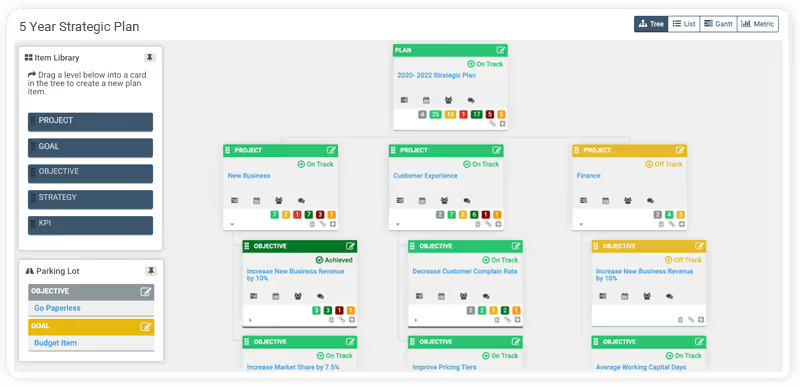
AchieveIt is a purpose-built integrated strategy management solution that helps teams track and report on multiple strategic plans on a single platform. Its focus on company performance management and the Objectives and Key Results (OKRs) framework is well-suited for medium to large enterprises.
AchieveIt works well for CEOs running compliance-led strategy processes, particularly in federal government agencies, education, and non-profits.
Key features
- One-click email updates, no platform login required for contributors
- Portfolio-level dashboard showing all strategic plans in one view
- Automated progress reminders and update requests
- Performance dashboards with real-time strategic tracking
- Document sharing and storage within the platform
Pros
- FEDRAMP certified, strong fit for U.S. federal government organizations
- Frictionless update process drives adoption in compliance-heavy organizations
- Strong visibility across multiple strategic plans
- Cloud-based and remote-team friendly
Cons
- Steep learning curve despite the simple update process
- No AI functionality or AI powered strategy insights
- Limited integrations. You can only connect other tools through an API.
- Limited reporting features force users to find workarounds when combining data.
- Interface is aging compared to newer platforms
Reviews
4.4 stars out of 5 on G2 (based on 199 reviews)
👉🏻 Compare Cascade to AchieveIt
Pricing
No free plan. They have 3 available paid plans—Core, Plus, and Pro—but no pricing is available on the website.
8. Smartsheet: Best for Work Management and Process Automation

Smartsheet is one of the most recognized work management platforms in the world, with strong adoption across operations and project teams. It's Excel-with-better-formatting at its core, and that familiarity drives fast adoption. However, it has no concept of strategic objectives, organizational alignment, or focus areas. It's designed to track whether tasks are getting done, not whether it’s connected to the strategy.
That’s why Cascade pulls data from Smartsheet via integration, so organizations can keep existing operational workflows while gaining strategic visibility.
Key features
- Grid, Gantt, card, and calendar views with spreadsheet-style familiarity
- Strong automation: Smart Flows, Bridge (low-code workflow builder), Data Shuttle
- 175+ integrations including bi-directional Jira and Salesforce connectors
- AI tools (Smart Assist, Smart Flows, Smart Columns, Smart Agents) for workflow automation
- MCP server launched March 2026
Pros
- Spreadsheet familiarity means fast adoption for operations teams
- Strong workflow automation capabilities
- Multiple views like Gantt chart, grid, and calendar
- Integrations with other tools like Google Drive, Salesforce, and Cascade—you can connect via Zapier to pull essential information into Cascade timelines, where you'll see more context.
Cons
- No native strategy execution model: no strategic objectives, alignment mapping, or focus areas
- Dashboards break or fail to display metrics correctly at high data volumes, per reviewer reports
- Executive reporting requires heavy manual setup
- AI suite automates tasks and workflows, it doesn't understand strategy
Reviews
4.4 stars out of 5 on G2 (based on +21K reviews)
Pricing
- Free trial: 30 days, no credit card required
- Pro $12/user/month
- Business $24/user/month
- Enterprise custom pricing
→ Add-ons cost extra
9. Betterworks: Best for HR-Led OKR Programs

Betterworks is an enterprise performance management platform that connects company strategy to individual execution through cascading OKRs, continuous feedback, and AI-powered insights. It's built for large organizations that want to replace annual reviews with a continuous performance management cycle.
It's an HR and people tool that uses OKRs as its goal-setting framework, built for People and HR teams rather than strategy and operations leaders.
Key features
- OKR goal-setting with continuous feedback loops
- Unlimited OKR coaching sessions
- Real-time activity stream and progress tracking
- Performance review and employee engagement tools
- HR-focused reporting
Pros
- Strong employee development and engagement focus
- Program insights make it easy to assess goals and KPIs.
- Unlimited OKR coaching sessions help employee engagement and development.
- Real-time activity stream keeps team members focused on priority actions.
Cons
- Focused on HR and performance, not organizational strategy execution
- Lacks flexibility as you can't build custom frameworks, it's focused on OKR scaling
- Can't attach files to projects or tasks
- Limited reporting options
- Plans start at 500 employees
Reviews
4.3 stars out of 5 on G2 (based on 221 reviews)
Pricing
They have two paid plans: one for mid-market (starting at 500 users) and one for enterprise (>2,500), but you need to contact sales to get a custom price since Betterworks doesn't provide pricing details on its website.
10. Wrike: Best for Operational Project and Work Management
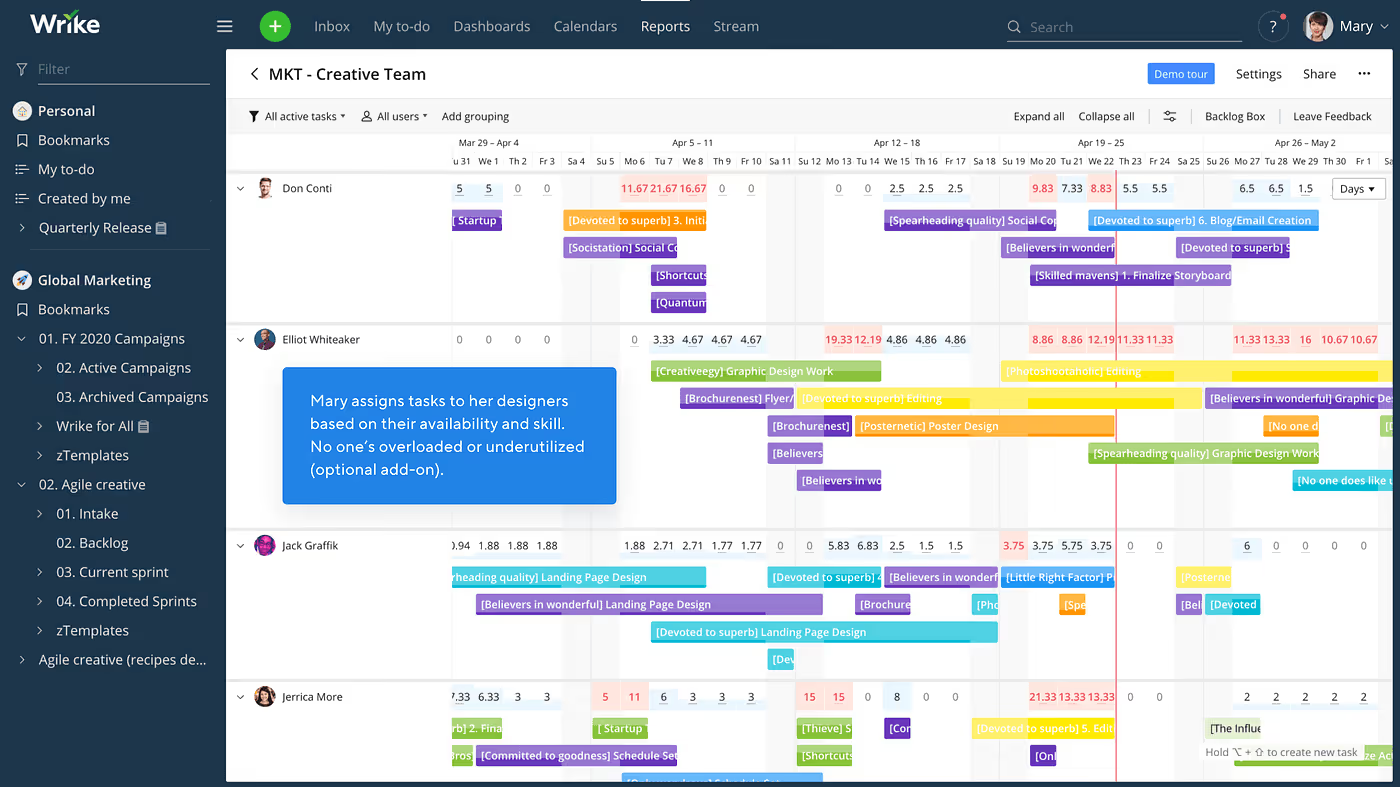
Wrike is enterprise work management software, very powerful for managing large volumes of projects, tasks, and workflows across operational teams. It's not a strategy execution platform. Its "OKR features" are custom item types built on top of a task management platform, they don't come with alignment maps, strategic health scores, cross-functional objective relationships, or metrics libraries.
Think of it as a complementary tool to strategy software, not a replacement. Cascade integrates with Wrike so organizations can connect operational execution to strategic goals without disrupting existing workflows.
Key Features
- Portfolio views, timesheets, and workload charts for operational visibility
- 400+ native integrations via Wrike Integrate add-on
- AI Agents (Triage, Risk, Intake, Agent Builder) launched February 2026
- Klaxoon acquisition adds whiteboard and visual ideation capabilities
Pros
- Great tool if you're looking for a simple task management solution
- Industry-leading operational work management depth
- Strong market presence with 20,000+ customers and broad enterprise credibility
- Advanced reporting available on paid tiers
Cons
- Being a project management software, it has limited capabilities for strategic planning and execution
- AI suite is focused on workflow automation and task completion, not strategic intelligence
- Limited to OKR methodology
- Steep learning curve, consistently flagged as the top complaint on G2 and Capterra, particularly at executive level
- Dashboards and reporting built for project managers, not CFOs or boards
Reviews
4.2 stars out of 5 on G2 (based on +4,5K reviews)
Pricing
- Free plan available
- Team $9.80/user/month
- Business $24.80/user/month
- Enterprise/Pinnacle on request (est. $35–50+/user/month)
What Are The Essential Features Of The Best Strategy Software?
Most of the tools on this market will tell you they handle strategy. Many of them handle projects, which isn't the same thing.
A project management tool tracks whether work is getting done. A strategy execution platform answers a different question: is the work that's getting done actually moving the strategy forward? Those are very different problems, and they need very different software.
For a platform to genuinely belong in this category, it needs to do six things well:
Connect plans to purpose. It should let you build a strategic plan, not just a task list, anchored to your organization's vision and long-term goals. The structure matters: themes, focus areas, objectives, initiatives, and KPIs should all link coherently, not float as separate lists.
Set goals that cascade. Objectives need to connect from the organizational level down to teams and individuals. When everyone can see how their work ties to the bigger picture, alignment stops being a talking point and starts being something you can actually measure.
Stay above the operational noise. The best platforms keep strategy visible at the right altitude. They're not where you manage tickets or track daily tasks, they're where leadership sees whether the organization is executing the right priorities.
Give you a portfolio view. If you're running multiple strategic initiatives across different departments, you need one place to see the health of all of them at once.
Track progress in real time. Goals need live data behind them, not numbers someone typed in last quarter. The closer your strategic metrics are to your actual business data, the faster you can respond when something drifts.
Drive strategic alignment. This is the hardest one. The platform needs to make it easy for every team to understand where their work connects to the overall direction and flag it clearly when it doesn't.
If the tool you're evaluating can't do all six of these things, it's probably a project management tool wearing strategy clothes.
How to choose the right strategy software for your organization
Answer these questions honestly before you start evaluating tools:
About your organization:
- How many teams need to be involved in strategy execution?
- Do you run a single methodology (OKRs, Balanced Scorecard) or multiple frameworks across different parts of the business?
- Are you in a regulated industry like government, healthcare, or finance?
About your current problem:
- Is your biggest challenge planning, execution, reporting, or all three?
- Do you need to track strategy at the organizational level, the team level, or both?
- How technical is your average user — will they log into a new platform every week, or do updates need to come to them?
About your resources:
- Do you have the budget and bandwidth for a 3–6 month implementation, or do you need to be up and running quickly?
- Do you have internal modeling talent to build complex planning environments, or do you need something out of the box?
- Do you need a free plan to evaluate properly before committing?
Once you have your answers, the right tool becomes clearer.
If you need a platform that handles multiple teams, multiple frameworks, and the full journey from plan to execution — that's exactly what Cascade is built for. Book a free demo to see how it works in practice.
FAQs
What's the difference between strategy execution software and project management software?
Strategy execution software connects organizational goals to the KPIs and initiatives designed to achieve them — with real-time visibility into whether the work is actually moving the strategy forward. Project management software tracks tasks and timelines. The difference matters because several tools on this list are the latter, and we say so clearly in each review. Tools like Wrike and Smartsheet are useful for project work, but they don't replace a dedicated strategy platform.
Which strategy execution software is best for large enterprises?
Cascade for organizations that need multi-framework, cross-team execution with real-time KPI visibility. Anaplan for large enterprises that need Finance, Supply Chain, and Sales aligned in one planning model. AchieveIt for government and healthcare enterprises that prioritize high adoption rates across non-technical users.
Is there a free strategy execution platform?
Cascade offers a free forever plan for teams of up to 4 users. Wrike and Hive also offer free plans — though these are project management tools rather than full strategy execution platforms.
What strategy frameworks does Cascade support?
OKRs, Balanced Scorecard, Hoshin Kanri, Portfolio Project Management, and custom frameworks. You can run multiple methodologies simultaneously in a single platform, which is one of the things that makes it different from every OKR-only or Balanced Scorecard-only tool on this list.
Can strategy execution software replace your Chief Strategy Officer or strategy team?
No. These tools make the strategy you have actually work, they don't build the strategy for you. A platform like Cascade gives your leadership team real-time visibility and AI-powered insights, but strategic decisions still require human judgment. Think of it as the operating system for your strategy, not a replacement for the people who set it.
How we built this list
This list was put together to give readers a comprehensive view of the strategy execution software market, not just the obvious category leaders. We deliberately included tools that serve different types of organizations: dedicated strategy execution platforms, OKR-focused tools, reporting-heavy solutions, work management platforms, and enterprise planning systems. The goal is to help you find the right fit for your situation.
Selection criteria: Tools were evaluated based on G2 ratings and review volume, feature depth across strategy planning and execution, real user feedback from G2 and Capterra, pricing transparency, and fit across different organization sizes and use cases.
Ordering: Tools are ranked by G2 rating, from highest to lowest. Where ratings are equal, review volume and category relevance were used as tiebreakers.
A note on bias: Cascade produced this article. We've done our best to represent competitors honestly, including their genuine strengths. Where we have internal competitive intelligence, we've cross-referenced it against public reviews and third-party sources. Pricing and G2 ratings were verified at the publish date (April 2026).

.png)

.avif)


