PAYSTRAX use Cascade across their entire business to keep them
razor-focused on strategy
Shared Strategy, Better Decisions: How PAYSTRAX Achieved 95% Adoption
PAYSTRAX
A financial technology company and licensed card acquirer providing European and UK merchants with solutions for their electronic transaction needs, from online payment gateways and point-of-sale acceptance to multi-currency settlement and fraud management. PAYSTRAX opened its first offices in Vilnius and Reykjavik in 2018, and holds principal acquiring licenses with both Visa and Mastercard. The company employs more than 170 specialists across five international offices, works with over 50 partners and serves more than 1,500 merchants across the EEA and UK.
PAYSTRAX exists to make something complicated feel simple. Its vision is to excel in simple solutions for complex payment acceptance, delivered from behind the scenes of everyday commerce where the company handles real money that belongs to real people. As a Principal Member of both Visa and Mastercard, it operates to the highest regulatory standard the industry has, which leaves no room for error, because the consequences land on consumers and merchants.
The company holds itself to the same standard commercially. It's growing fast while staying profitable, with founders who came into the business with real experience in payments. But as PAYSTRAX passed 170 employees across six offices, the way it managed its own strategy had fallen behind the rest of how it operates.
The Challenge: Running a Fast Company on a Slow Spreadsheet
As a fintech, PAYSTRAX uses technology tools wherever it can. It runs a dedicated data team working in Microsoft Power BI to extract value from enormous amounts of data it possesses. For quite some time, strategy was the exception. Like most companies, PAYSTRAX ran it mostly in Excel.
Excel could hold the plan, but it couldn't move it. Getting data into a spreadsheet automatically is hard, so anything that wasn't automated became manual work someone had to repeat, cycle after cycle. And a fast-growing company couldn't work meaningfully in a single spreadsheet, which left the strategy hard to communicate, hard to track, and hard to change at the speed the rest of the business was setting.
Power BI handled (and still does) the detailed numbers well, but it was never built for strategy. That gap matters more in payments than in most places – PAYSTRAX competes for demanding clients in a crowded field, and if it isn't fast, the competition is.
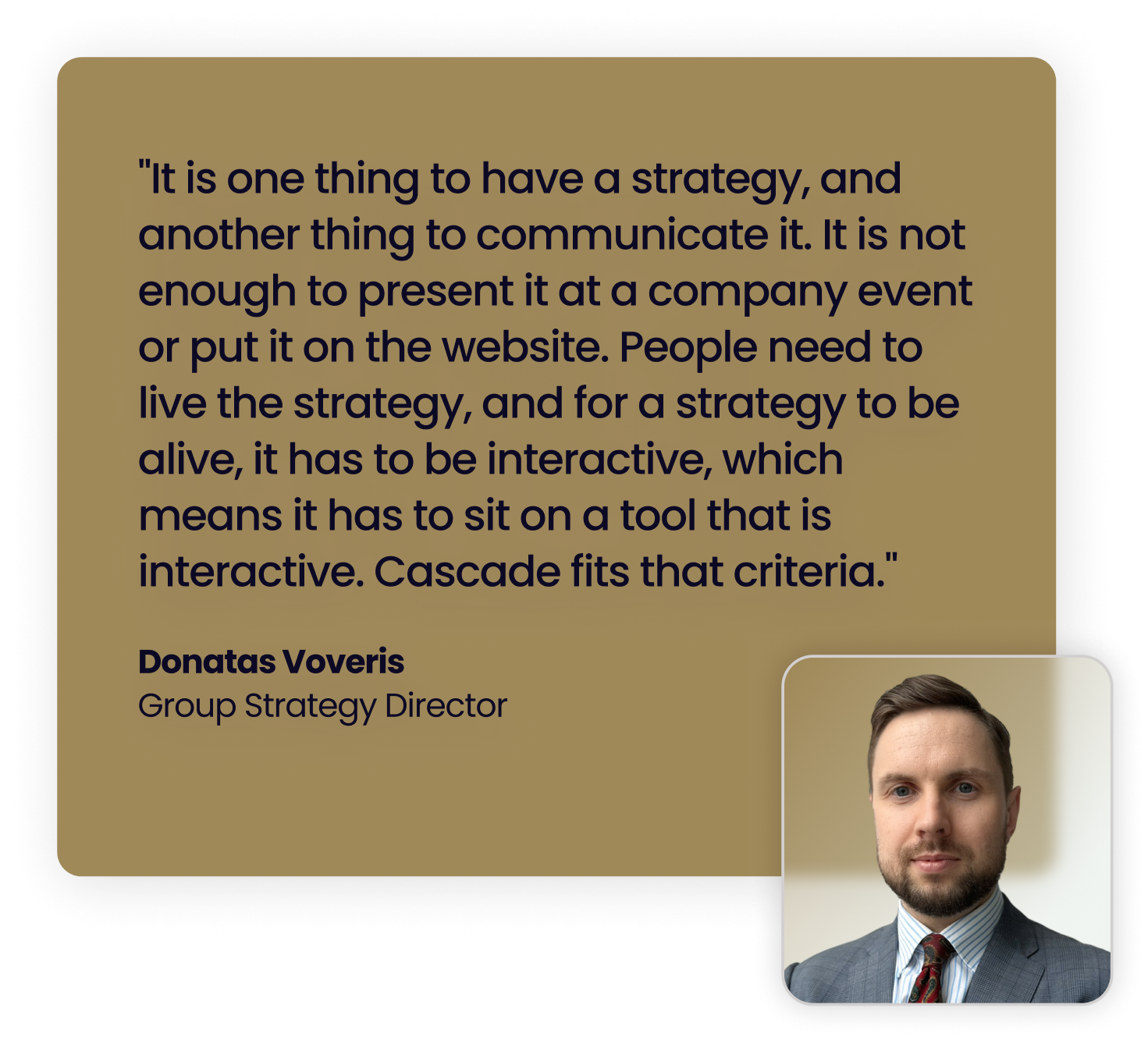
"Being a progressive company, we decided we needed a proper tool for strategy. We already have proper tools for most other things we do. It is part of the company DNA. Strategy was the one thing still running on a spreadsheet," says Donatas Voveris, Group Strategy Director at PAYSTRAX.
The Solution: Choosing a Tool Anyone Could Operate
Donatas compared at least ten strategy tools before settling on one. Cascade came out ahead on three counts.
Easy to use. Hands down, the number one criterion, because a tool that only specialists can operate solves little at PAYSTRAX's scale.
Visual. Cascade could plot different types of data on a single chart and show them across a long horizon, which Power BI was never built to do.
Clean Snowflake integration. Cascade connected directly to Snowflake, the data warehouse PAYSTRAX already ran, so strategy data could come from the same source the rest of the business used.
The rollout began with the management team, though the intention from the first day was to put the company's strategic data in front of everyone. PAYSTRAX opened access across the organization at the start of 2026, and today, every employee is in Cascade. All teams now maintain their own reports, some further along than others, and managers present from the platform in management meetings, so the numbers are live in the room instead of assembled into slides the week before.
The most visible expression of all this is in the offices themselves, where Cascade reports run on screens showing the main KPIs the company tracks. The detailed Power BI dashboards still have their place for the team, but the screens everyone walks past carry a simplified view any employee can read at a glance. PAYSTRAX believes in transparency between the business and its people, and putting the numbers on the wall is what that commitment looks like in practice.
The strategic projects that sit alongside those KPIs live in Cascade too, tracked as initiatives and reviewed every month, so the work and the numbers it moves sit in the same place.
Underneath the visibility sits a discipline the company didn't go looking for. PAYSTRAX only puts what it calls clean data into Cascade, which means that before anything goes in, the team has to answer a series of questions about it and strip out reference points that carry no real meaning. The process takes time, and it's the reason the company has been deliberate about what it adds, but it has also raised the standard of the data the whole business runs on.
The Results: Numbers Over Emotions
Donatas describes the move from Excel to Cascade as trading a bicycle for a proper German car, a comparison he offers as someone who owns both.
Opening the platform to everyone changed more than access. Around 95% of PAYSTRAX employees with access to Cascade use it every month, and engagement holds across the organization instead of concentrating in a few teams.
The bigger shift is in what teams do with the numbers. Several teams tracked no KPIs at all when PAYSTRAX started and now maintain somewhere in the range of 30 to 50 each, because entering and changing data in Cascade is quick enough that adding one isn't a project. Anyone can build a report and changes take minutes, so the only real limit is whether the data exists.
Employees can also see where those KPIs sit. Anyone at PAYSTRAX can open Cascade and find the company's strategic objectives with the KPIs underneath them, where previously the strategy lived in a separate system and stopped there.
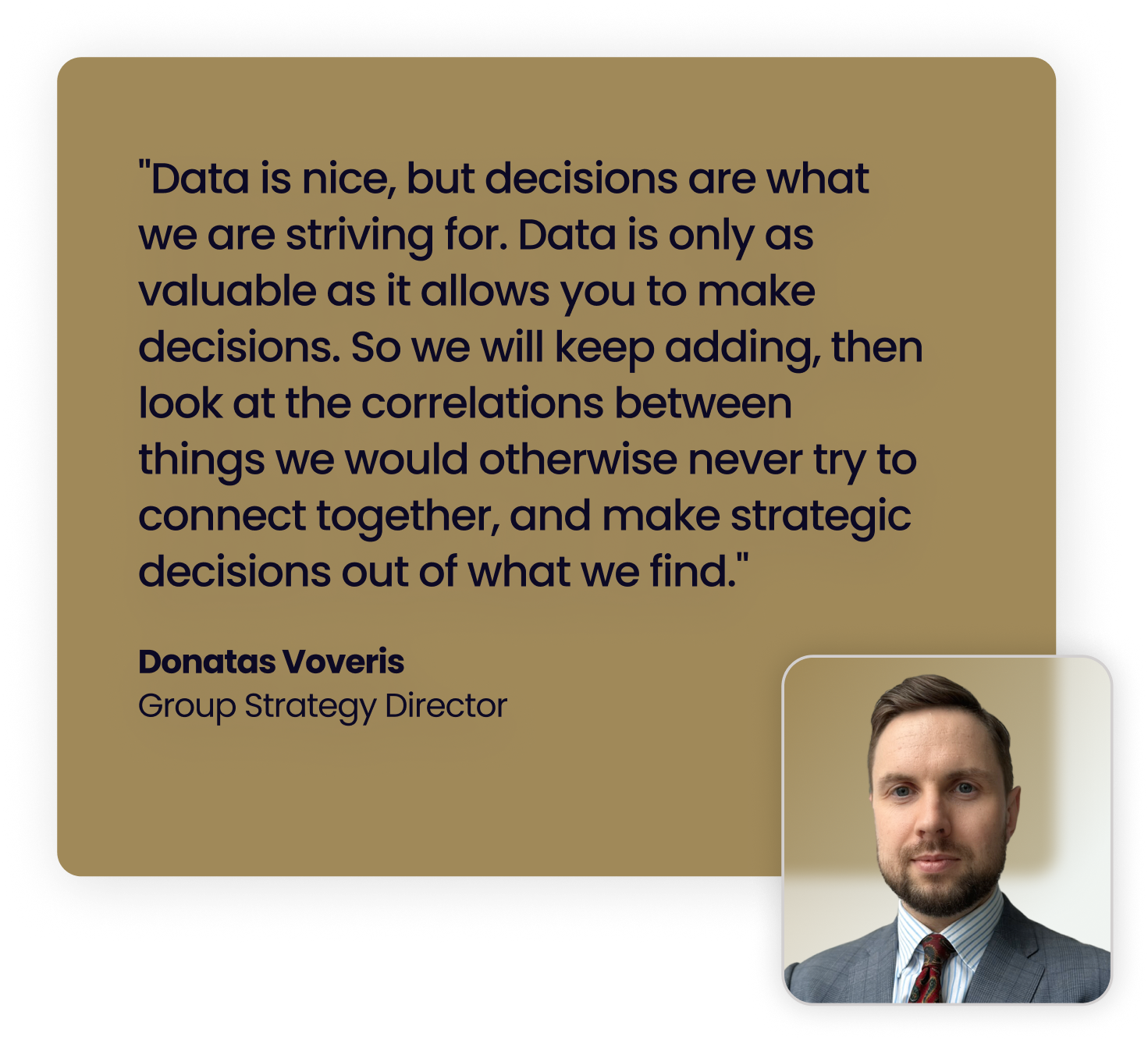
The most consequential change was one the company wasn't looking for. Plotting different types of data on a single chart in Cascade, across a long enough horizon, surfaced correlations PAYSTRAX had never thought to connect. One of those combinations changed how the company plans, giving the business a more credible picture of the future with more certainty.
"The change I did not expect was in how people think about KPIs. They used to be seen as a control tool, and some of our teams did not believe in them at all. Now they use them to understand how we are performing and where we should focus, because in Cascade it is easy for them to enter data and easy to change something. In two years, those teams went from zero to hero, and our management discussions are now based on numbers rather than emotions, which is a very different conversation to be in," says Donatas.
The Impact: Adding Data Without Lowering the Standard
Getting here took time and resilience. Moving a company off spreadsheets and onto a dedicated strategy system isn't an easy process, and PAYSTRAX credits the belief of its top management, including the CEO and the CPTO who co-founded the business, for carrying it through the stretch where the benefits weren't yet obvious.
One of the platform's strongest champions is the company's Group Chief HR Officer, who maintains a large set of regularly updated HR KPIs that give leadership a much clearer view of what's happening with the team. That people data now sits beside transaction data is a reminder that even a fintech is, in the end, a people company.
Next, PAYSTRAX plans to add considerably more data points to Cascade, holding to the same clean data standard that has made the existing set trustworthy. The ambition is a sharper platform.



.png)
.png)

.avif)
.avif)