


Most strategies are made in a room, at a leadership offsite or through a consulting engagement that can cost millions of dollars. The strategy might be to expand into Japan or to grow through acquisitions, but according to Charlie Newark-French, Cascade's CEO, it rarely makes it into what people actually do each day.
"There might be some great kickoff on January 10th, and everyone says this is the direction we're heading. And then none of the business cadence, none of the business actions, none of the culture follows that whatsoever." - Charlie Newark-French
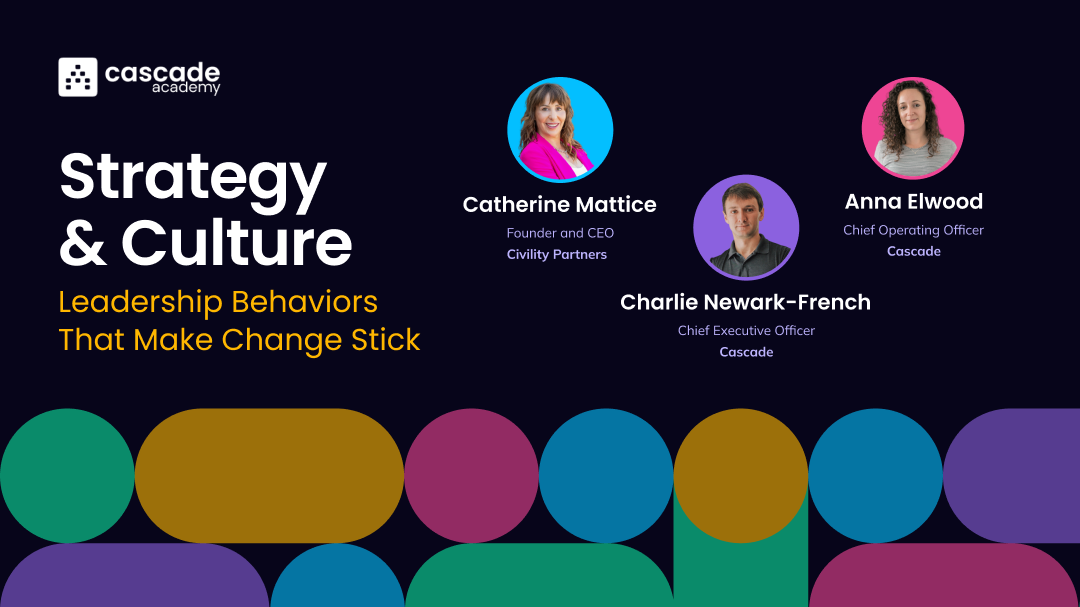
That gap between the plan and the day-to-day was the starting point for our recent panel, Strategy & Culture: Leadership Behaviors That Make Change Stick.
Charlie, who started his career at McKinsey, brought the strategy view. Catherine Mattice, founder and CEO of Civility Partners and author of Navigating a Toxic Workplace For Dummies, brought two decades of helping organizations rebuild trust and psychological safety.
Anna Elwood, our COO, moderated. She opened with something we see across Cascade customers: adopting a strategy platform does change how people work, and the change comes from what it brings with it. Organizations start approaching strategy differently, connect their goals to it more clearly and, in the end, need different behaviors day to day to deliver it.
Catherine defines culture as the way people think and the way they act as a result. She sees a direct link to strategy: when someone on the front line has goals attached to the company's plan, they feel part of something bigger, and that sense of connection is part of what makes a culture healthy.
Over the hour, she and Charlie kept arriving at the same conclusion from opposite directions, which is that culture is part of how a strategy gets delivered.
Retire the Breakfast Line
When Anna brought up the old saying that "culture eats strategy for breakfast", Catherine said that hearing it is like nails on a chalkboard for her.
The line is usually credited to Peter Drucker and repeated without much thought, and her problem is with what it assumes: that culture and strategy are two separate forces, and that culture is the one that matters more. In her view, culture is part of the strategy, and planning for it belongs right next to planning for budget, hiring and marketing.
"If we're expanding to Japan, it's not just how are we going to make the money, where's the team, what's the advertising. That's all important, but so is how do we need to treat people to get them there? How do we manage their performance? How can we be sure that managers understand how to communicate about change?" - Catherine Mattice
Target and Kmart show what that looks like in practice. Both launched around the same time with fairly similar stores, and today Kmart has all but disappeared, while Target made the way it treats people part of its strategy from the start. You can still feel it when you walk in.
Facebook's old motto, "move fast and break things", is a case where the culture and the strategy were the same sentence. For years it shaped how the company innovated, pivoted and shipped software. It's also no longer the motto, and for Catherine that's the most useful part of the story, because the culture changed as the company did.
"Strategy is meant to evolve, and so is culture. We run up against clients who are like, 'well, we've had these core values for 100 years', or 'the owner made them in the 50s'. It's like, things are different now." - Catherine Mattice
Plenty of organizations still treat their core values like scripture that can't be rewritten, even as circumstances change and different behaviors start to lead to success.
Look Past the Executive Floor
Everything a leader does gets amplified roughly ten times across the organization. People constantly read small signals, like whether an executive shows up to a review prepared or turns up late, and they spread their conclusions about what really matters.
Words are a different story. A leader's behavior travels fast, but a direction announced once rarely sticks.
"Just saying on January 10, this is the direction we're heading, that's not enough. You need to say on February 10th, right, we're sitting in a room for three hours to discuss how this is going. You have to keep repeating." - Charlie Newark-French
Still, the popular idea that culture starts at the top only goes so far. In a small company like Catherine's, everyone interacts with the CEO. In a firm the size of McKinsey, most people never see what the CEO does day to day, so their experience of culture comes from their manager and the colleagues around them.
"Someone says, 'Oh, do you like working there?' Nobody's saying, 'well, the CEO has set a great culture.' It's 'I like my team,' 'I don't like my manager,' or 'this person's kind of an idiot.' We talk about the daily interactions." - Catherine Mattice
A study from about ten years ago found that around 60% of people who leave their jobs do so because of their manager or immediate team.
There's a hopeful side to this: if culture isn't only set at the top, everyone has a say in it. People choose how they show up and how they react, they can make their own team a safe place to speak up, and over time those small habits can bring others along, even if one person can't change the direction of the whole company.
Watch What You Reward
High performers who hit every goal while working against the culture are one of the most common problems Catherine sees, and the individual is rarely the whole story.
Leaders sometimes build a business that depends on one person's sales numbers, that person rarely behaves badly in front of the leader, and they've often been rewarded for their results for years. So when HR eventually tells them to be nicer, they're getting mixed messages, and so is everyone else watching.
"As long as leaders tolerate that behavior, then the core values are totally irrelevant. This behavior is rewarded." - Catherine Mattice
The test Charlie applies is fairly ruthless: can the behavior be repeated and scaled?
"If you have one seller that comes in and goes, 'I'm not updating Salesforce, I'm not following your pricing, but every quarter I'm going to bring in a million dollars of new business'. You can't repeat or scale that. It's maybe a crutch to survive the next quarter. But that's not a strategy." - Charlie Newark-French
Results that depend on one person working around the rules are hard to build a strategy on. And every time that person gets promoted or celebrated anyway, the rest of the company learns which behaviors actually get rewarded.
Be Honest About Short-Term Trade-Offs
The harder cases sit in the middle. A strategic plan is about the long term, but sometimes a company has to hit this quarter's number just to stay alive, and it's tempting to let some things slide.
Think of it as a ship in a storm. You need to get through the waves in front of you, and the question is whether the way you do it will stop you from reaching shore. Tolerating toxic behavior will. Taking on a difficult customer because you need the revenue probably won't, as long as the team is candid about the choice.
"We're going to all look at each other very frankly and say we're going to take this on, and this is the reason we're going to take it on. But this is not part of our long-term strategy." - Charlie Newark-French
Those honest conversations are much easier when the culture was healthy before the storm hit. Teams that trust each other will push through a hard month together and still speak up when someone needs a break. Teams held together only by growth tend to fall apart the moment the numbers dip.
Measure the Culture Itself
Culture can feel vague and hard to pin down, so the first step is to treat it like any other business problem: diagnose what's actually happening, then set objectives that address what you find.
The diagnosis is where most companies go wrong, because they use an engagement survey as if it were a culture survey. Engagement is an outcome of culture and a lagging indicator, and it can look healthy even when the culture isn't.
"You can be engaged because you like the mission of the company and you like your immediate team and your work feels the right amount of challenge for you, and also be in a toxic work environment." - Catherine Mattice
A real culture survey goes wider. The one Civility Partners runs looks at engagement alongside job satisfaction, inclusivity, relationships and internal communication, so it shows how the organization functions as well as how people feel about it.
Catherine also looks for culture in three places, which she calls the OIL model: organizational behavior, individual behavior and leadership team behavior. Most people only think about individuals, but if one of your core values is innovation, it's worth asking whether your own processes, down to onboarding, are innovative too.
Build Culture Into the Plan
When we polled attendees on how culture shows up in their current strategic plan, most said it's embedded in specific action items. Only a few had made it an objective of its own.
Catherine's rule of thumb: if your plan has five objectives, one of them should relate to culture. Decide what kind of culture the strategy needs, whether that's psychological safety or customer service, and then plan the work that gets you there, from training people to checking whether your processes actually let teams serve each other.
Culture doesn't always need its own line in the plan. Toyota's strategy in the 1980s was 'zero defects', a quality goal on paper, but the culture showed in how much power people had to act on it: any junior employee could stop the assembly line if they spotted a problem.
What doesn't work is culture as a separate idea sitting outside the handful of directions the company is heading in.
Link today's rewards to tomorrow's strategy
Even when everyone agrees on where the company needs to go, people tend to follow what they're rewarded for today. Kodak invented the digital camera and ended up with almost no presence in the camera industry. Its leaders could see that printing photos wasn't the future, but distribution, advertising and bonuses were all built around printing, so people had every reason to resist the change.
Charlie's fix is to connect the long-term direction to short-term milestones, borrowing the idea behind Atomic Habits that many small steps add up to something much larger.
"If you say to people, this month our print is going to fall by 10%, but we're going to get digital cameras out into these seven different outlets, and that's what success looks like for this month, and that's by the way how your bonuses are paid this month, then you'll find the short-term links exactly to that." - Charlie Newark-French
We see the same thing with Cascade customers. The link between long-term strategy and day-to-day work holds when it's tied to clear numbers that teams review every week or month. Once progress is discussed regularly, it becomes part of how the business runs, and nobody wants to show up to the next review with nothing to report.
Put a Number on Bad Culture
Part of the reason leaders don't prioritize culture is that it doesn't show up in the profit and loss statement, but its effects show up elsewhere. When a culture improves, decisions get made faster because teams stop going around in circles on the same issues. People who trust each other also collaborate more, which feeds productivity and, eventually, revenue.
The cost can be dramatic. At a ski resort Catherine works with, the ski patrollers went on strike just as the holiday season began. Officially, they were holding out for an extra dollar in pay, but the real issue was a toxic culture that leadership had never addressed. The resort was effectively closed for two weeks, right in the most important stretch of its year. That meant two weeks of lost revenue at peak season, and a direct hit to the revenue goals the resort's strategy depended on.
"It's never about pay. People say 'I'm not getting paid enough'. What they're saying is: 'I'm not paid enough to put up with this', whatever this is." - Catherine Mattice
Problems like this rarely appear overnight. Paying attention to culture regularly is what catches them early, before they turn into a crisis.
Pick One Thing
If you don't know where to begin, start small. Pick one thing that will genuinely change your culture, and skip anything performative.
That one thing doesn't need to sit apart from your strategy, either. Strategy sets the direction, and culture decides whether people actually move in it, through how decisions get made, what gets rewarded and how people treat each other along the way.
"Culture is how things are done in the short term, day to day, how businesses actually operate, and that has to ultimately link to strategy. So they're one and the same thing, really." - Charlie Newark-French
So instead of culture eating strategy for breakfast, the two should be having breakfast together.
___________________________________________
This article is based on a webinar hosted by Cascade, featuring Catherine Mattice (Founder and CEO, Civility Partners) and Charlie Newark-French (CEO, Cascade), moderated by Anna Elwood (Chief Operating Officer, Cascade). You can watch the full recording here.

.png)

.avif)


