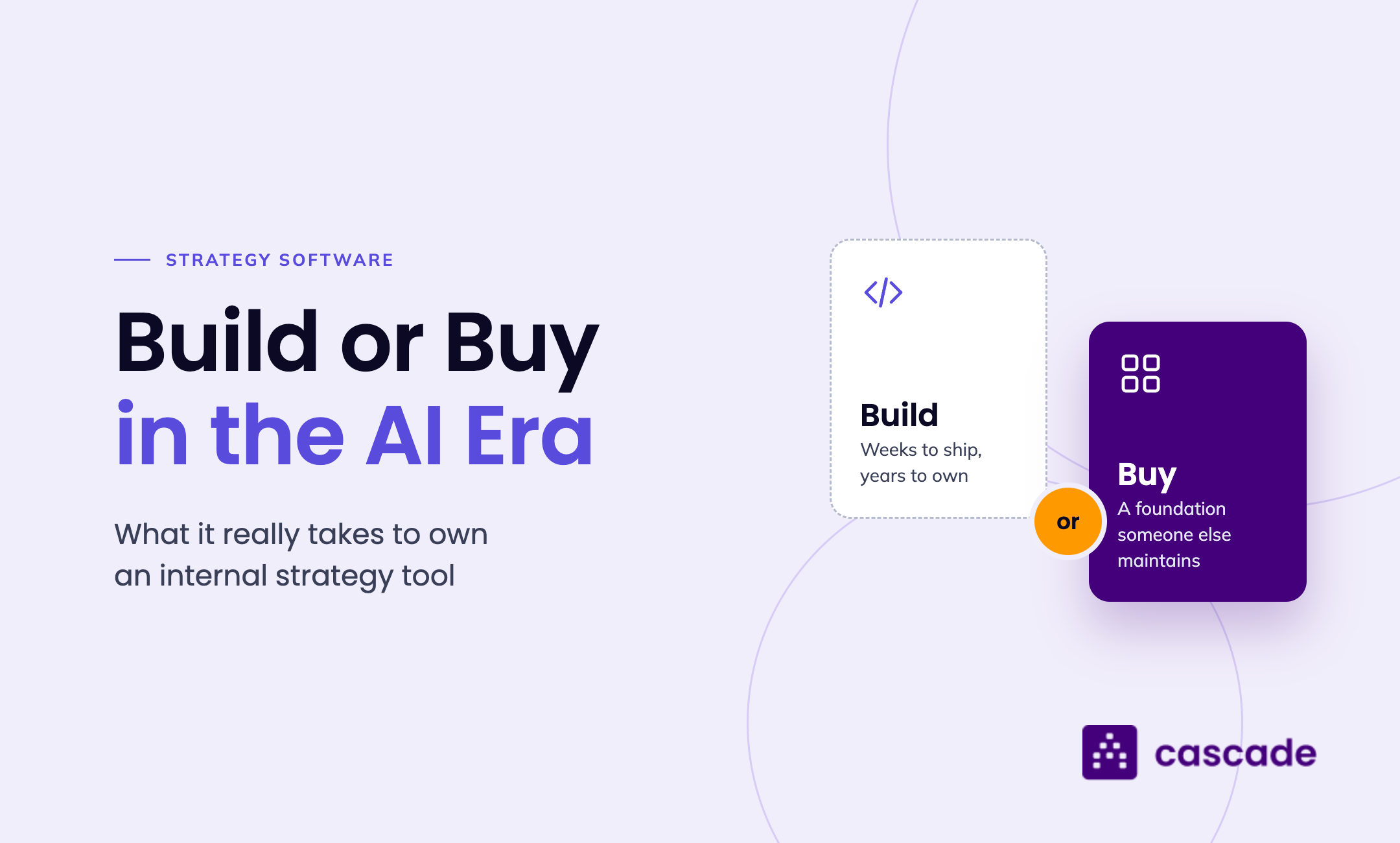

Two years ago this was a short conversation. Today it's a fair question, and it deserves a real answer.
Somebody on your team could build a strategy tracker in a couple of weeks. Objectives with owners, a progress rollup, a dashboard the exec group looks at on Monday morning. Two engineers with AI assistance, maybe a product manager sketching screens. It would work, and it would probably look good.
If your team has looked at this and told you they could have something workable in front of the leadership group by the end of the quarter, they're probably right.
Which leaves a question most people skip past:
You can build it. Does that make it the right decision?
The short version: AI has made software much easier to build, for your team and for every software vendor. It hasn’t made business-critical software easier to own, and owning it is where almost all the cost lives.
What owning an internal strategy tool involves
Getting to a first version is a project. Running it for the next three to five years is a different job, and it's the part that's hard to see from the meeting where the decision gets made.
Permissions: a series of judgment calls
Your team can anticipate this, and most do. The problem shows up later, when it turns out the correct behavior is genuinely hard to settle and the cases keep arriving long after the model was built.
Consider a confidential initiative sitting inside an objective the whole division can see. Does its progress feed the parent's rollup? Include it and the number quietly tells everyone that something exists they aren't allowed to see; leave it out and the number they're looking at is wrong. Both answers are defensible, and which one is right depends on how your organization handles that kind of thing.
Then the rest arrive at their own pace: somebody who answers to two leaders in different parts of the business, contractors who need scoped access to a single program, a person changing roles whose access should change while the updates they wrote last year stay exactly where they are, and eventually a restructure that moves the hierarchy the whole model was attached to.
None of it is unforeseeable. What makes it expensive is that each case becomes a design decision made once, mid-quarter, by people meeting it for the first time.
Governance: whether the record stays true
Someone has to own what the definitions mean, which matters most when two divisions both track something they call customer retention and calculate it differently.
Someone also has to settle whether a target that moves mid-quarter is recorded as a change or quietly replaces the original. Internal tools tend to allow the second, because editing a field in place is the obvious way to build it, and the cost surfaces much later, when the board asks what you committed to in Q1 and the only available answer is whatever the field says today.
Requests need the same kind of ownership. Each one arriving is perfectly reasonable on its own: a view that matches how one division is structured, a field for finance, an exception to the hierarchy for the program that doesn't fit it.
Every small yes is defensible, and the accumulation is what turns a data model anyone could follow into one that needs explaining.
Security: an obligation that keeps running
You review it once before launch, and then the responsibility carries on. Dependencies age and need patching, somebody needs a plan for the day something goes wrong, and eventually a customer, an auditor or a board committee asks what assurance exists over the system holding your strategic plans.
A vendor does that work once and spreads it across every customer it has. An internal tool carries the same obligation for one system, as a side responsibility of a team with other priorities, which is where the quiet risk sits: internal systems get deprioritized precisely because they're internal, and the tool holding the most sensitive material in the company becomes the one nobody has looked at properly in a while.
Integrations: the part with no end date
The reason to build this at all is usually that you want live numbers rather than a spreadsheet someone updates on a Thursday, which means pulling from your finance system, your CRM, and whatever your delivery teams work in. Wiring each of those up is a piece of work that finishes. Keeping all of them running is the part that doesn't.
When they break, they rarely break loudly. An API version gets deprecated with six months' notice that nobody at your end reads, or a field is renamed upstream and the mapping silently starts returning nothing. The tool carries on displaying a number the whole time, so a broken integration looks exactly like a healthy one until somebody in a review says a figure doesn't match what they know to be true, and by then it's been wrong in front of people for a while.
Roadmap: it only improves when someone chooses it
An internal tool improves in the quarters where somebody argues for it over customer-facing work, and that argument is hard to win against a revenue feature, which means it usually gets made once and then quietly stops being made at all. Nobody decides to freeze the thing, it just stops moving.
What makes that costly now is the pace around it. Expectations of what this kind of software should do have moved considerably in two years, mostly because of what AI made possible, and they'll keep moving.
All of this matters before you decide, because the decision gets made while the tool is still a two-week project, and nobody revisits it later. The minute someone reallocates a team on the strength of a number it produced, or a report from it lands in a board pack, it stops being a side project and becomes business-critical infrastructure. It has to be right every time somebody looks at it.
What building with AI leaves behind
Cheap building doesn't only affect the project in front of you, it changes what accumulates around it.
One agreed system becomes several
Assume this is done properly: real sponsorship, everyone aligned on a single system. That removes the obvious version of the problem, where three divisions build three trackers because none of them knew about the others.
What it doesn't remove is what happens a year in. A division needs something the tool doesn't do, the backlog runs to next quarter, and rather than escalate they build around it, with a sheet that feeds the tool or a dashboard layered over the top.
Nobody is going around the system to be difficult. What AI changed is that going around it now takes an afternoon instead of never happening at all, and each workaround arrives with its own definitions, its own author, and no owner a year later. Which is how a company that agreed on one system ends up reconciling numbers again.
The AI you put inside it
Nobody trains their own model, so an internal build will call a commercial model API for its AI features. That's a reasonable engineering choice and the one most teams would make, but asking a model which initiatives are at risk means sending it the initiatives.
Your restructure scenarios and headcount plans travel out of your infrastructure every time somebody uses the feature, which puts a few things on people's desks that nobody scoped. Legal has to read the provider's terms and decide whether they're acceptable for material that isn't public yet. If you've committed to anyone that data stays in a particular region, somebody has to establish where the processing actually happens.
And what began as a review of an internal tool becomes a review of a system that ships confidential strategy information to a third party, which tends to be a slower conversation with a more senior set of people.
Your AI is only as good as the layer underneath it
Here's the part of this decision that has changed most, and it isn't really about strategy software at all.
Every organization now wants to ask its AI real questions about the business:
- Which initiatives are at risk
- Where two divisions are funding the same outcome
- What we committed to the board in Q1 and what happened to it
- Whether the thing we approved in March is delivering what it promised.
The models are not the constraint, everyone has access to roughly the same ones. The constraint is context, and this year's McKinsey State of AI survey shows the gap that creates:
80% of respondents say AI has improved their own productivity, while only 37% report any positive contribution to their organization's EBIT, essentially unchanged from last year. Individual output is up, but enterprise results are flat. What separates the organizations closing that gap, in McKinsey's reading, is that they change how the business works rather than adding AI tools to it.
Point an AI at a typical organization's strategy today and what it finds is decks in SharePoint, a planning spreadsheet in four versions, Jira tickets describing work without saying why it was funded, dashboards reporting outcomes with nothing connecting them to the decisions meant to produce them, and whatever survives in meeting transcripts and email.
From that it can only infer what the organization decided, and inference is precisely what you don't want sitting underneath a board conversation.
What changes the answer is a record where those relationships are written down rather than inferred. Each objective knows which KPIs measure it. Each KPI knows which initiatives are meant to move it. Each initiative carries an owner, the things it depends on, a running history of updates, and a link back to the decision that created it. Strung together, that's the chain an AI can actually follow:
Objective → KPI → initiative → owner → dependency → update → decision → outcome
That chain is what turns a question into an answer. It's how an AI knows that a KPI drifting is connected to an initiative that slipped, which was owned by a team that lost two people in March, which was flagged in an update nobody escalated, which traces back to a decision made in a review last October. No amount of model capability substitutes for that, because the connections either exist in the record or they don't.
This is also where an internal build runs into something it can't solve with more engineering. A model will design you a sensible structure in an afternoon. What it can't do is keep it true: the integrations still feeding, the definitions still shared across divisions, the history intact after several years and a change of owner.
A semantic layer is not a design artifact. It's a maintained one, and maintaining it is a permanent job rather than a project.
Which reframes the whole decision: you aren't only choosing a strategy platform. You're choosing where your organization's strategic context is going to live for the next five years, at a moment when that context is becoming the most valuable input your AI has.
Raise the bar for what you buy
There’s one more piece of the economics, and it’s the one most build-versus-buy conversations miss.
AI coding tools have made it far easier for your team to build software in-house. They’ve done the same for every software company. A well-run SaaS company is pointing those tools at a single product, with a team that works on nothing else and a backlog shaped by hundreds of customers. Whatever speed your engineers gained, the vendor gained too, and they’re applying it with far more focus than an internal team fitting the work around its day job.
So the core economics of building versus buying haven’t really changed. What should change is what you expect from the software you buy. A vendor that can ship faster than it could two years ago should be improving the product every quarter and bringing you capabilities you hadn’t thought to ask for. All of that should come on top of what this article has already covered: the permissions model, the maintained integrations, the certifications and a record that holds its shape through a restructure.
That’s the test worth applying to any strategy platform in 2026. Ask whether it’s moving at the pace AI now makes possible, and hold it to that.
Buy the foundation, build what's yours
You didn't build your CRM. You didn't build payroll, or the data warehouse, or the identity provider everything else signs into. You bought foundations, and spent your building energy on the things that make you money.
The useful question here is the same one: What can we buy that gives us a working foundation now, so the effort goes into what only we can do?
Building a strategy platform fails that test twice over: you'd be recreating infrastructure that already exists in mature form, where the best available outcome is parity with what you could have bought, using the people who could have been pointed at the thing only your organization can build.
For strategy, the foundation is the specialized part: a data model that survives a reorganization, permissions that hold up across divisions, integrations somebody else maintains, certifications already in place, and a record that holds its shape as the organization changes underneath it.
That's where Cascade, our AI-powered Strategy Execution Platform comes in. One system holding the plan, the work against it, the live numbers and the decisions that come out of them, all referring to the same record. Metric definitions sit in a shared library wired to the systems that produce the numbers. It ships with SSO, role-based access, granular view permissions and audit logs, holds SOC 2 Type II and ISO 27001 with AES-256 encryption, and offers data residency in the US, EU or Australia. It connects natively to Power BI, Excel, Google Sheets and Microsoft Teams, and keeping those connections working is our job rather than yours.
Powering it is Tapestry, our intelligence engine, which weaves the quantitative data arriving from those integrations together with the qualitative context from your teams, their updates, their meetings, the documents nobody reads twice, and maps all of it against the strategic priorities already in the platform. That's the chain from earlier, working as intended: connections recorded rather than inferred, so what comes back is where leadership should be spending its attention rather than a plausible guess.
And since we built Tapestry in-house, it ensures your intelligence is isolated, encrypted, and strictly yours. Your data is never used to train public AI models.
Cascade: What you're actually buying
The platform is the obvious part, and everything around it is where a lot of the value sits.
You get strategy specialists who have watched hundreds of organizations attempt this, including the ones where it came apart, which is why they'll tell you in week two that the way you've structured your objectives is going to cause trouble by month six. You get a CSM whose actual job is your rollout, rather than a colleague fitting it around the work they were hired to do. And behind both of them there's a product team building whatever the last hundred customers turned out to need, so a good deal of what arrives is something you'd never have thought to ask for.
Which is what the next three to five years look like from the other side of this decision. The permissions questions have been settled by somebody else already, the integrations are still feeding, and when procurement asks for a certification it exists. The record can be trusted, which is what makes the AI reading it worth asking. And the quarters your teams would have spent maintaining all of that go instead into the strategy the software was only ever there to hold.
PepsiCo, Aramco, the University of Notre Dame, WWF, US Bank and St. Jude Children's Research Hospital are among the organizations running their strategy on Cascade. If you're weighing this decision, book a demo and see what it looks like with your own strategy in mind.
Frequently asked questions
Can we build our own strategy software with AI?
Yes. An engineering team with AI assistance can produce a working strategy tracker, with objectives, owners, progress rollups and a dashboard, in a matter of weeks. The question worth asking is what happens after that, since the first version is the small part of the commitment.
What does it actually cost to run an internal strategy tool?
The visible cost is the build. The recurring cost is everything that follows: access control that has to handle confidential initiatives and restructures, integrations that need maintaining as source systems change, security patching and certification, support for everyone using it, and a roadmap that only advances when somebody wins an internal argument for it. That work continues for as long as the tool is in use, and it usually falls to people hired to do something else.
Doesn’t AI make software vendors less necessary?
AI makes it easier for everyone to build software, and that includes vendors. A SaaS company with a dedicated team uses the same tools on one product full-time, so the gap between what you could build and what you could buy stays roughly where it was. The difference is that buyers should now expect vendors to ship faster and improve more visibly than they used to.
Why does AI make a strategy system of record more valuable?
Because the constraint on enterprise AI is context rather than model capability. To answer questions about strategic performance, an AI needs the relationships recorded: objective to KPI to initiative to owner to dependency to update to decision to outcome. Without that structure it infers intent from decks, spreadsheets, tickets and dashboards, and an inference is a poor foundation for a board conversation.
Can we build now and move to a platform later if it doesn't work out?
You can, and some organizations do. The cost is that you pay for two rollouts rather than one, and the second is harder, because people who have already been asked to adopt a strategy system once are slower to do it again. Migration is also rarely clean, since an internal tool's data model reflects decisions made by one team early on.
If we buy a platform, what's left for our team to build?
The parts that are specific to you. Your governance and reporting cycles, the plans themselves, the metrics you decide are worth watching, the systems you connect so numbers arrive automatically, and the reporting and recommendations you generate from your own data.