


TL;DR:
Strategy execution software helps healthcare organizations, from hospitals to multi-site health systems, turn a strategic plan into owned, tracked work across departments and facilities, and connect that work to the measures leaders already report on, from readmissions to HCAHPS to throughput. Cascade is a strategy execution platform built for this in healthcare: it runs the plan across every site, links daily execution back to system goals, and gives leaders a live view of what is on track and what is slipping.
A health system's strategy usually looks sharp in the board deck and then loses contact with the floor. The readmissions target sits with quality, the HCAHPS plan sits with nursing, growth goals sit with each region, and none of those teams can see the others. Add a merger or a new facility and the plan fragments further. The strategy didn't fail because it was wrong. It failed because nothing connected it to the daily work once the offsite ended.
That gap is what strategy execution software closes. Below is where it costs the most in a hospital or health system, and how Cascade handles each one.
Use Cases in Hospitals & Health Systems
Four use cases come up in almost every healthcare organization, and each breaks in its own way. Reducing readmissions, improving the patient experience, aligning across sites, and reporting to the board are different problems with different failure points, and strategy execution software addresses each on its own terms.
Reduce hospital readmissions
You cannot manage a readmission rate directly. It is an outcome, set weeks after discharge by a chain of upstream decisions: how the discharge was planned, whether medications were reconciled, whether anyone followed up. Each of those levers sits with a different team, so the number a leader is held to is one no leader actually holds.
The penalty raises the stakes on a problem that is already hard to run against. By the time a weak quarter posts, the care behind it is months gone and the reduction is locked in. The rate can only be managed after the fact, which is too late to change it. The place to catch a readmissions problem is upstream, in the program that is quietly slipping while the patients it affects are still being discharged.
Cascade puts the number back under one owner and connects every program working on it to that goal, so the full effort is visible in one view and slippage surfaces while there is still time to change the outcome. The readmissions objective stops being a line in a quality report and becomes a live goal with the contributing work hanging off it.
- One owner, one structure: The readmissions objective sits in the Planner with a named owner. Each contributing program, from a transitional care clinic to a follow-up call protocol to medication reconciliation, ladders up to it as an initiative with its own owner and health score, so the whole effort lives in one structure instead of four disconnected trackers.
- A live rate in every review: The readmission KPI updates automatically from your source system, so reviews run on the current number rather than one pulled together the previous week.
- Early warning before the rate moves: Health scores turn on a contributing program that is falling behind before that shows up in the rate, and Cascade's AI links the stalling initiative to the readmission goal it threatens and raises it early.
- Reviews that start on the number: Cascade requests updates from each team on a set cadence and assembles the review, so the meeting opens on where the rate is and which program is dragging it, instead of chasing status.
The shift is from managing readmissions after the penalty to steering the programs behind them in the quarter they still count. A leader can see the specific initiative pulling the rate down and act on it while it matters.
Improve HCAHPS and patient experience
Every leader can name the HCAHPS drivers, and most systems have a plan that covers all of them. The plan is rarely what holds the score back, the feedback is. Scores arrive quarters after the care, aggregated to the point where they show the result without the cause, with nothing in between to steer by. A unit can push hard on discharge communication for a full quarter and not know whether any of it landed until the survey posts.
So patient experience gets run in bursts. Scores come in low, attention spikes, a few units get pushed, and focus drifts until the next results land. The daily behaviors that move the score are never tied to the score itself, so the effort and the result float free of each other, and no one can tell which push actually worked.
Cascade closes the distance between the daily work and the score by tying every experience driver to an accountable team and a leading measure that moves before the survey does. Patient experience becomes something a leader can steer week to week instead of a verdict that arrives once a quarter.
- Every driver has an owner: Each driver becomes an initiative linked to the HCAHPS domain it affects and the manager accountable for it, so the plan stops being a shared document no one owns.
- Signal before the survey posts: Leading indicators like rounding completion, call-light response times, and discharge-education checklists sit in the Metrics library beside the score, so teams can see whether the work is landing between survey cycles.
- The reason next to the number: When a domain dips, the qualitative note explaining why sits beside it in the review, so the conversation moves straight to cause instead of speculation.
- A check on where effort really goes: AI Strategy Intelligence audits where patient-experience work is actually concentrated across the organization, so leaders can tell whether the plan on paper matches the effort on the floor.
The result is a patient-experience program that runs continuously instead of resetting every quarter, with leaders acting on leading signals well before the trailing scores confirm them.
Align strategy across sites and regions
Alignment is the problem that scales with the org chart. A single hospital can keep its plan in a few people's heads but a system of a dozen facilities across several regions cannot, so each entity ends up planning on its own. The instinct is to pull everyone onto one template, which is usually where it breaks. Impose a single template and local teams quietly keep running their real plan on the side. Leave every site to its own devices and the system has no shared view of whether anyone is moving in the same direction.
The cost does not show up on a slide. It shows up as two facilities funding the same initiative without knowing it, as a regional priority that never connected to the system goal it was meant to serve, and as a board that receives a stack of local reports it cannot reconcile into one picture.
A merger makes the gap acute overnight, but any system large enough runs into it, and the bigger it gets the wider it runs.
Cascade holds the whole system in one strategy model, so direction is shared at the top while each facility, region, and function owns its execution underneath. Leadership gets one line of sight across every entity without flattening how any of them work.
- One model, many owners: System objectives sit at the top, and each facility and function builds its own plan beneath them that ladders up. Vertical and horizontal alignment show in a single map, so it is clear how a unit-level initiative connects to a system goal.
- Alignment you can measure: AI-calculated alignment scores show how much of the local work is actually influencing system priorities, and flag the plans that have drifted onto their own track.
- Duplication surfaces instead of hiding: Cascade detects the same initiative running separately at two sites and flags it, so overlap becomes a decision rather than a surprise found at budget time.
- Local rhythms stay intact: Each entity keeps its own frameworks and cadence while reporting into the same structure, so alignment does not cost local teams the way they work.
Cascade runs at large multi-entity systems, including academic networks like UNC Health and the University of Maryland Medical System and systems like Franciscan Missionaries of Our Lady Health System.
Emplify Health, the 11-hospital system formed by the 2022 merger of equals between Bellin Health and Gundersen Health System, shows the pattern in detail. A year into the merger, strategy lived in slide decks and spreadsheets, and two regions would sometimes run the same project under different names without ever comparing notes. Emplify rebuilt its strategy in Cascade around one set of enterprise goals, with each region and team owning its piece underneath.
"Cascade allows leaders to come in from a high level, zoom in, and understand where to start to diagnose the barriers or roadblocks to achieving the goals, earlier than before." — Katie Nowak, Director of Strategy, Emplify Health
Report to the board and to regulators
By the time a board report is finished, it usually describes a system that has already moved on. The numbers live in one place, the story behind them lives in inboxes and meeting notes, and pulling the two together is a manual job that eats the week before every board meeting. What lands in the board pack is a snapshot of where things stood when someone started assembling it, already out of date by the meeting.
In a multi-entity system that scramble repeats at every level, and each hand-off loses fidelity. A facility summarizes for its region, the region for the system, the system for the board, and the context that would explain a red metric thins out at every step. Boards end up with clean-looking slides and no way to interrogate them, and compliance reporting carries the same exposure in a setting where the stakes are higher.
Cascade builds board-ready reports from the live plan, so the numbers and the reasons behind them stay current and connected instead of being reassembled by hand each cycle. The report becomes a view into the running strategy rather than a document rebuilt from scratch every quarter.
- Board packs built from live data: Reports assemble in the platform from current numbers, by connecting to the organization’s existing systems, using templates and a drag-and-drop builder, and export to PDF, PowerPoint, or Excel when the board wants a file.
- The narrative captured as it happens: Tapestry Connect drafts the updates behind each number from the meetings, emails, and files where the work is discussed, with a person approving each one, so context reaches the board instead of evaporating on the way up.
- Decision-ready summaries: AI executive summaries surface the wins, the risks, and the items that need a board decision, so the meeting spends its time on judgment instead of orientation.
- One roll-up, controlled access: The same structure rolls up from facility to region to board without re-keying, and access controls keep sensitive plans visible only to the people who should see them.
What Strategy Execution Software Is, and What it Isn't
When healthcare organizations evaluate strategy software, they keep running into three categories described in the same language, and it helps to separate them.
- Market intelligence tools like Sg2, Trilliant Health, and Definitive Healthcare tell you what is happening in your market and service lines.
- Financial planning tools like Strata Decision Technology and Synario model your budget and scenarios.
- Strategy execution software runs the plan that decides what to do with what those tools surface.
Cascade is a strategy execution platform. It does not forecast your market, model your budget, or manage patient records. It tracks the operational and performance measures those systems produce, like the readmission rate and the HCAHPS score, and turns them into owned initiatives, tracked KPIs, and decisions, which is why health systems often run it alongside their other systems.
How Cascade Helps Hospitals & Health Systems
Cascade helps healthcare organizations such as hospitals and health systems, run their whole strategy in one place: it digitizes the plan, connects the data and the daily work to it, and runs Tapestry, its AI engine, across all of it to surface what needs attention. It does this at healthcare organizations as different as St. Jude Children's Research Hospital and regional systems like Cone Health and Deaconess, and its value shows up in a few specific ways.
A live plan within 30 days
A health system's strategy is scattered across board decks, PDFs, and spreadsheets, often a separate set for every entity. Cascade's AI imports those files directly, from PowerPoint, Excel, or PDF, removes the duplication, and structures them into one connected plan with the alignment between levels already drawn.
Most healthcare organizations digitize their strategy and run their first leadership meeting in Cascade within 30 days, so getting a multi-entity plan into one system reads as weeks of work rather than a year-long rollout.
Faster decisions in leadership meetings
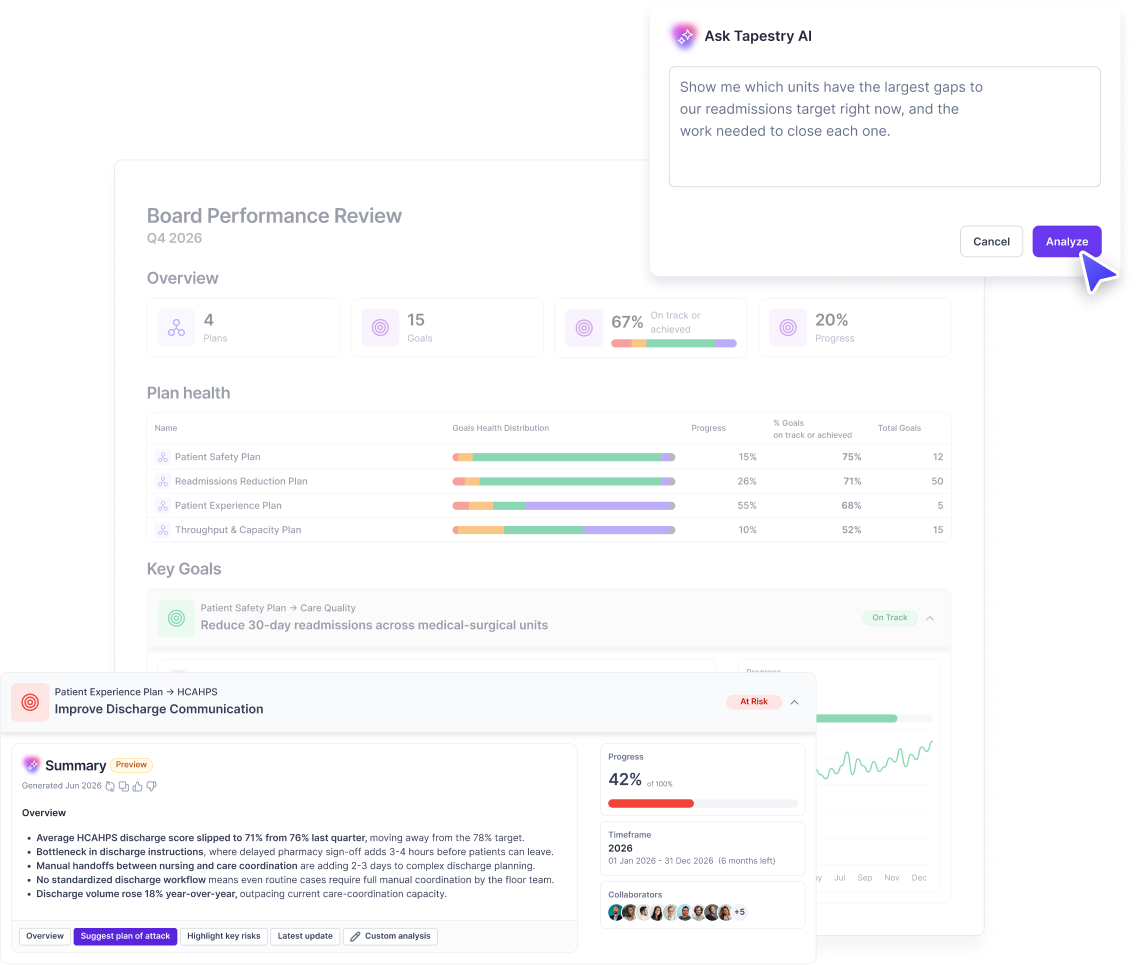
Most reviews recap the past. Cascade runs the monthly or quarterly review on live data, with AI-built executive summaries and agendas ready before anyone walks in. The Analyze button returns a read on any objective, its risks, and a suggested course of action, and leaders can put a question to the whole plan in plain language and get an answer in the room. The meeting spends its time on the decision instead of on assembling the picture.
One view across clinical, operational, and financial goals
Health systems run clinical quality, operations, and finance at once, usually in different tools and different frameworks. Cascade's Metrics library pulls those numbers in through integrations with your EHR reporting, BI tools, data warehouses, and spreadsheets, and metric trees roll sub-measures up into the system KPIs leaders report on.
Each measure links to the objective it supports, so a quality initiative and the margin target it moves sit in the same view. Teams keep working in the systems they already have while the strategy and the reporting come together in one place.
Accountability without chasing
Every objective, initiative, and KPI carries an owner and a health score, and alignment scores show how each team's plan connects to system priorities. Progress data syncs automatically from the tools teams already work in, from Jira and Smartsheet to Teams and Slack, so status is visible without anyone assembling it.
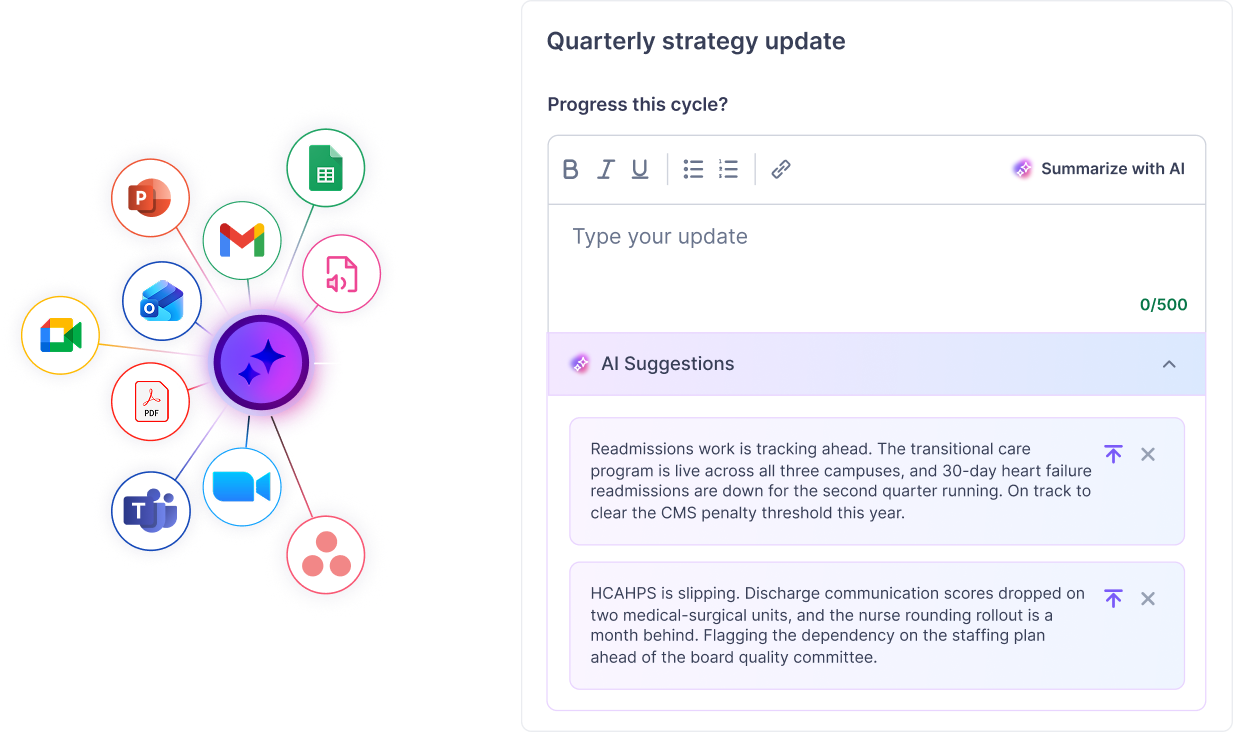
The written updates take care of themselves too: Tapestry Connect reads the meeting transcripts, emails, and documents where work gets discussed and drafts the update for each owner to approve, so no one is chasing people for a status report. Cascade runs the cadence on top of that, requesting anything still missing on schedule, building the reports, and sending them out, which is the strategy governance most offices still do by hand.
Foresight instead of firefighting
Tapestry watches the whole plan for risks, blockers, and dependencies, including connections between work that looks unrelated across departments, and raises them before they land as a missed target. It pushes briefings to executives on the themes they care about without their having to log in.
Its Strategy Intelligence audits where effort is actually going, answers whether the system is doing what it believes it is, and reframes the strategy through a lens like the Balanced Scorecard with no setup.
Security fit for health system data
Tapestry AI is built in-house and never trains public AI models on your data. Cascade holds SOC 2 Type II and ISO 27001, encrypts data with AES-256 in transit and at rest, and supports single sign-on, role-based access, audit logs, and data residency in the US, EU, and AU.
Keep Strategy Connected to the Work
A health system's strategy fails the same way whether it runs one hospital or twenty: the plan gets set, then it drifts from the work. Cascade keeps the two connected, from the readmission target on a unit floor up to the strategy the board signs off on.

FAQs
What is the best strategy execution software for healthcare?
For most hospitals and health systems the best fit is Cascade, which runs strategy execution across multiple sites and frameworks rather than as a single-scorecard reporting tool. The right choice depends on your setup: systems focused on Balanced Scorecard board reporting also shortlist ClearPoint, and AchieveIt is another option teams consider for tracking adoption. Cascade's advantage in healthcare is aligning many facilities under one strategy while each keeps its own plan, with AI that flags risk and drift early.
What is healthcare strategy execution software?
Healthcare strategy execution software helps healthcare organizations, including hospitals and multi-site health systems, turn a strategic plan into tracked, owned work across departments and facilities, and connects that work to the measures leaders report on, such as readmissions, HCAHPS, and throughput. Cascade is a strategy execution platform built for this, running the plan across every site and giving leaders a live view of what is on track and what is slipping.
What's the difference between strategy execution software and healthcare market intelligence or financial planning tools?
They answer different questions, though healthcare organizations often lump all three together when evaluating options. Market intelligence tools like Sg2 and Definitive Healthcare tell you what is happening in your market, and financial planning tools like Strata model your budget and scenarios. Strategy execution software like Cascade runs the plan that decides what to do about all of it, turning goals into owned initiatives and tracking whether they get delivered.
Can strategy execution software run across multiple hospitals and facilities?
Yes. Cascade is built for multi-entity health systems, so providers, departments, and facilities connect in one strategy model while each local team still manages its own execution. Emplify Health, a system of 11 hospitals and more than 100 clinics formed through a merger, uses Cascade to align across sites without forcing every facility onto one rigid template.
Which strategy frameworks does healthcare strategy execution software support?
It depends on the platform. Cascade runs any framework, including OKRs, the Balanced Scorecard, and custom models, so a health system does not have to change how it already plans. That flexibility matters in healthcare, where clinical, operational, and financial goals often sit in different frameworks at the same time.
Is Cascade secure enough for health systems?
Cascade works with operational and performance data rather than patient records or protected health information. It holds SOC 2 Type II and ISO 27001 certifications, encrypts data with AES-256 in transit and at rest, and supports single sign-on, role-based access, audit logs, and data residency in the US, EU, and AU. Its AI engine, Tapestry, is built in-house and never uses your data to train public AI models.

.png)