
.png)


TL;DR:
The best AI strategy execution platform in 2026 is Cascade with a 4.8 rating across 236 reviews in G2. Other platforms include WorkBoard, Wave by McKinsey, ClearPoint Strategy, and Profit.co. While a lot of people use general-purpose LLMs like ChatGPT, Claude, Gemini, and Perplexity for strategy, these play a different role. They're the thinking and research layer, not the execution layer, although some strategy platforms increasingly use LLMs as part of their AI engines.
An AI strategy platform is a system of record, a one source of truth for the organization’s strategy, with built-in AI capabilities for planning, tracking, and decision-making. It stores the strategic plan, breaks it into owned work across teams, integrates operational data from tools teams use everyday, surfaces performance issues before they escalate, and drives the strategic governance cycles. The objective is to connect that top level plan to work on the ground and provide an accurate picture of performance.
Cascade's 2026 Strategy Report surveyed 1,112 business leaders and found that 74% cannot consistently access the data they need to make strategic decisions. AI strategy platforms exist to close that gap.
The 5 Best AI Strategy Execution Platforms + 5 Special Mentions
Cascade
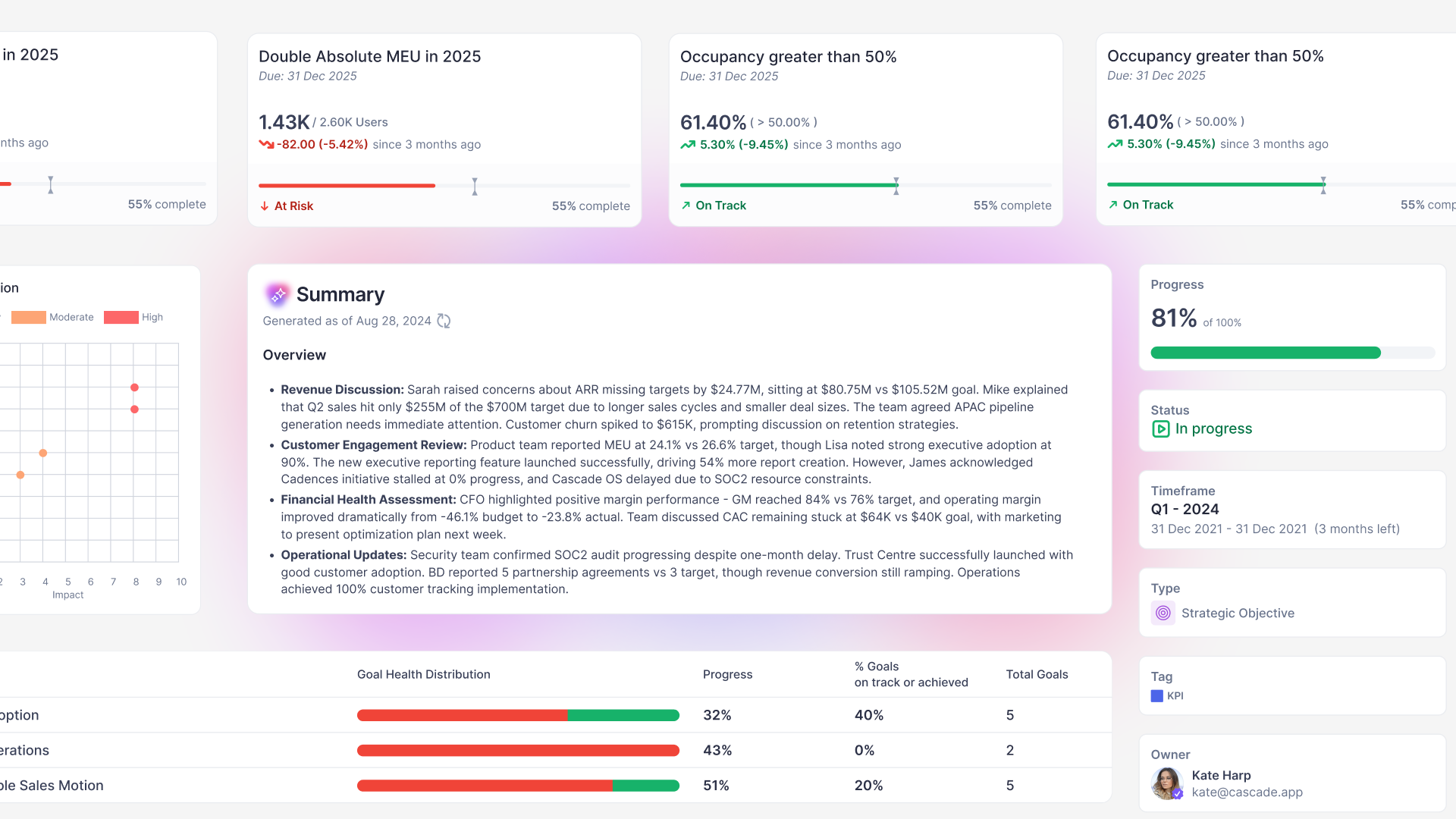
Cascade is the leading AI-powered strategy execution platform, built to help leadership teams make better, smarter decisions and run their business through strategy. Cascade becomes the strategic command center that connects data, human context, and AI processing to turn plans into action and strategy into a live operating rhythm. It’s best suited for mid-market and enterprise companies running multi-team strategies that have outgrown strategy decks and spreadsheets. The platform is used by global organizations from all industries like St. Jude’s, US Bank, WWF, PepsiCo, and Telefónica.
Key AI capabilities
Cascade's AI capabilities are powered by Tapestry AI, the platform's intelligence engine. Tapestry weaves together quantitative data (from integrations) with human context (meetings, emails, files, documents) and matches it to strategic objectives to give leaders a complete picture of what's happening across the business. It powers six built-in capabilities:
- AI Assisted Planning turns existing strategy decks, spreadsheets, and PDFs into a structured live plan, with auto-alignment between parent goals and contributing initiatives.
- Tapestry Connect captures context from meetings, emails, tools, sheets, and files, matches it to the right objectives, and drafts business updates for teams automatically.
- AI Reports & Meetings lets leaders interrogate live data in natural language ("Why is revenue off-track?") and auto-generates executive summaries of wins, risks, and blockers. It also builds suggested plans of attack to recommend leaders actionable steps.
- AI Risks & Dependencies scans the entire portfolio in real time to surface invisible blockers and cross-team dependencies before they escalate.
- AI Executive Briefings delivers weekly digests configured around the themes each leader cares about (margins, sales, specific initiatives).
- AI Strategy Intelligence audits whether actual execution matches strategic intent and lets leaders interrogate the entire workspace through custom prompts.
Pros
- Tapestry AI is built in-house with AES-256 encryption, SOC 2 Type II compliance, and zero training on customer data, rather than wired into a public model.
- Breadth of frameworks (OKRs, balanced scorecard, hoshin kanri, custom) plus 500+ integrations means Cascade fits whatever planning style is already in place.
- The free forever tier (up to 4 users, unlimited plans, unlimited metrics) is the only true free plan in the strategy execution category.
- Over a decade in the strategy execution market, with a category-leading 4.8 rating on G2 and named a Leader in the Strategic Planning and Execution category.
Cons
- The breadth of features that make Cascade powerful for enterprise strategy can feel like more than smaller teams need.
- All training materials, including videos, guides, and webinars, are available only in English, which can slow rollout for teams operating primarily in other languages.
- Cascade requires a structured implementation rather than a self-serve sign-up, though the strategy services team supports customers through the process, and most are up and running within 30 days.
Pricing
Free forever for up to 4 users; Essentials and Enterprise+ on request. For more information visit Cascade’s pricing page.
Reviews
4.8 stars out of 5 on G2 (based on 236 reviews), leader in the Strategic Planning and Execution category.
If you need an AI-native strategy execution platform built to handle your business strategy from plan to delivery, we'd love to help set you up for success. Contact our sales team when you're ready.

WorkBoard
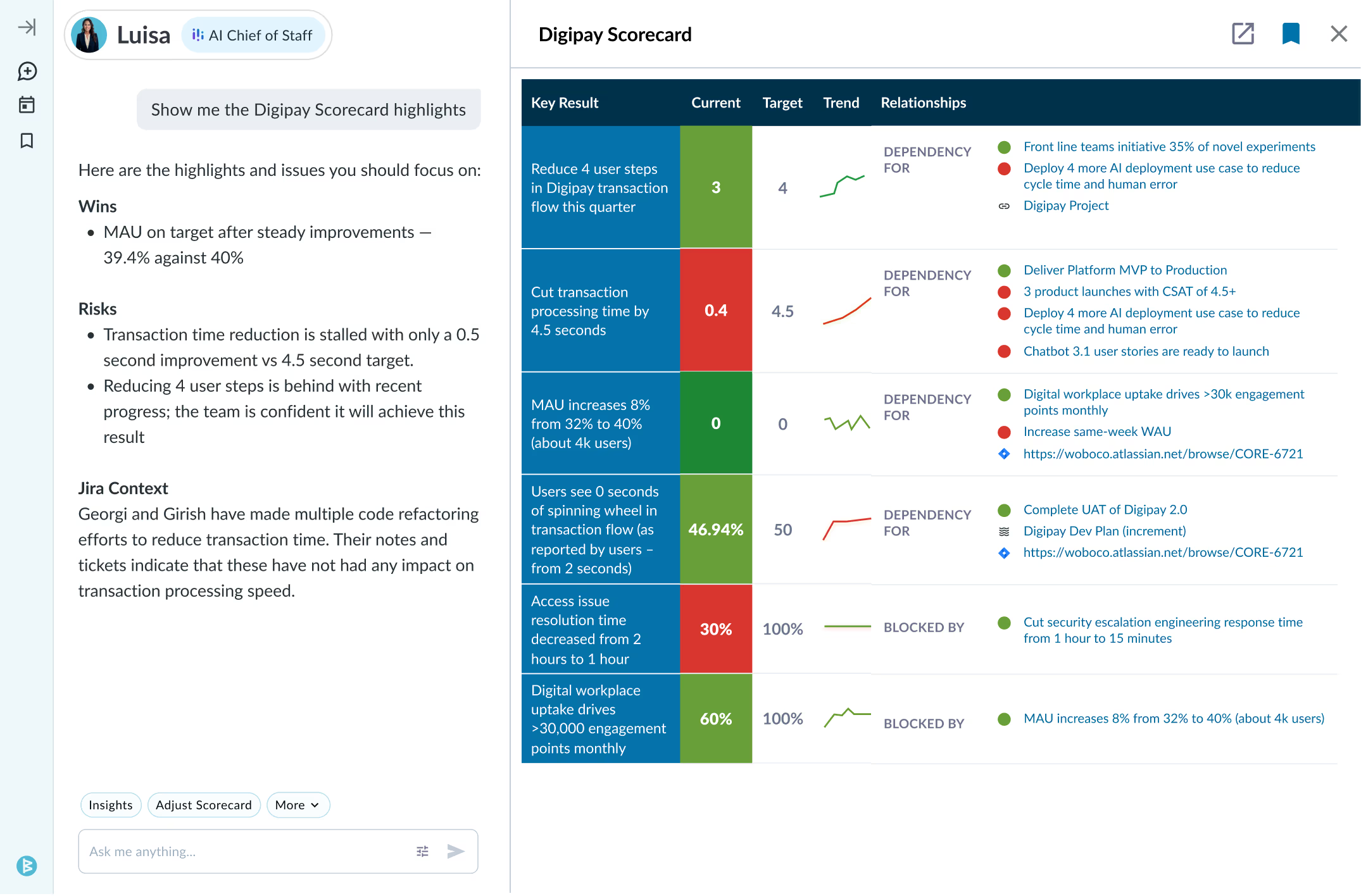
WorkBoard is an enterprise OKR and strategy execution platform. After its May 2025 acquisition of Quantive (formerly Gtmhub), the two products are being merged under the WorkBoard brand, with Quantive customers folded into the WorkBoard platform. Best for large enterprises running OKRs at scale, particularly Microsoft 365 or Workday shops.
Key AI capabilities
- Chief of Staff agent nudges teams on alignment and accountability, surfacing issues that need executive attention.
- Leadership Coach agent provides AI-driven coaching, feedback prompts, and growth plans for managers.
- Microsoft Copilot integration brings goal updates and progress recommendations into Microsoft 365.
- Dynamic scorecards update automatically as data flows in from connected systems.
Pros
- Built specifically for enterprise OKR programs, with deep methodology around setting, scoring, and reviewing objectives at scale.
- The Microsoft Copilot integration connects OKR updates with Microsoft 365 chat, valuable for organizations already running on the Microsoft stack.
- Workday integration (through a formal co-sell partnership) makes WorkBoard a natural fit for organizations standardized on Workday for HR and finance.
Cons
- Several of WorkBoard's strongest AI features are tied to the Microsoft and Workday ecosystems, so organizations not standardized on those stacks get less out of the platform.
- Users mention a steep learning curve and adoption challenges outside engineering and product teams.
- OKR-first design means it's narrower than tools that support multiple strategic frameworks like balanced scorecard, hoshin kanri, or custom methodologies.
Pricing
WorkBoard does not disclose its pricing on the website; you’ll need to contact their team.
Reviews
4.7 stars out of 5 on G2 (based on 103 reviews)
Wave by McKinsey
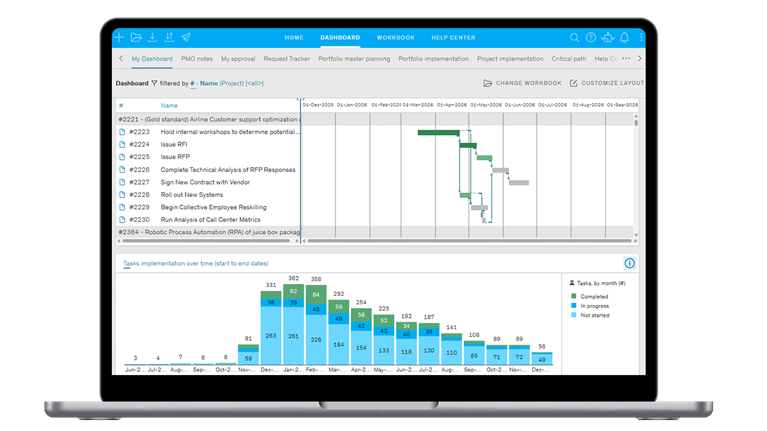
Wave is McKinsey's program management platform, bundled with McKinsey transformation consulting engagements, so it’s not sold as standalone software. Built around the firm's transformation methodology, Wave is designed for tracking large-scale transformation programs from initiative through to financial impact. It’s best for large enterprises that are looking not only for software but to hire consultancy services or that are already engaged with McKinsey on multi-year transformation programs.
Key AI capabilities
- AI-powered opportunity identification that draws on McKinsey's vast knowledge base of tracked transformation initiatives to surface opportunities and benchmarks.
- Custom AI agents support planning, predict risks, and accelerate decision-making across initiatives.
- AI coaching provides built-in training and guidance as users work through transformation initiatives.
- Gen AI-enabled value tracking that combines financial and non-financial impact metrics with automated workflows.
Pros
- Built around McKinsey's transformation methodology, with sector-specific configurations for telecommunications, oil and gas, procurement, M&A, and sustainability.
- Customers can benchmark their transformation against anonymized data from peer programs in the same sector
- Dedicated solution advisers work with customers throughout deployment.
Cons
- Access requires an active McKinsey consulting engagement and is priced at McKinsey rates rather than enterprise SaaS rates.
- Keeping the platform means keeping the McKinsey engagement, which means staying on consulting-tier costs year after year.
- Configuration changes typically run through McKinsey rather than being self-serve, which can slow the strategy cycle and iterations.
- Reporting and integration capabilities are narrower than purpose-built strategy execution platforms, with limited native connectors to operational systems like Jira, Salesforce, and Workday.
Pricing
Since it’s sold only with McKinsey consulting engagements, the pricing varies by contract.
Reviews
Not listed on G2
ClearPoint Strategy

ClearPoint is a strategy execution platform built around objectives and key results (OKRs) and Balanced Scorecard methodologies. It serves a broad mix of sectors with their main strength being local government, NGOs, and public sector organizations. The platform is best for companies in regulated sectors where stakeholder reporting is constant.
Key AI capabilities
- ClearPoint AI is built on OpenAI's API, with PII removed and data anonymized before transmission rather than processed in-house.
- AI Assistants guide users through OKR creation, scorecard building, and framework-based planning across multiple methodologies.
- Ask Me Anything answers natural language questions about scorecard data, while the Recommendation Engine surfaces suggestions based on data patterns.
- AI Exception Reports highlight off-track measures and initiatives, with options to forecast performance, rebuild charts, and recalculate targets.
Pros
- Native integrations with the BI and project management tools strategy teams already use, including Power BI, Tableau, Jira, Monday, etc.
- Public dashboard capabilities for organizations that need to publish performance reports externally
- Carahsoft partnership for federal, state, and local government procurement, which simplifies purchasing for public sector buyers
Cons
- AI capabilities are powered by OpenAI's API rather than a purpose-built strategy engine, with data sent externally for processing rather than handled in-house.
- AI focuses on assistant-style chat, plan creation, and reporting rather than deeper portfolio-level intelligence.
- ClearPoint markets itself heavily on Balanced Scorecard, but the Balanced Scorecard Institute formally recommends Cascade as its software partner for strategy execution.
- Reviewers consistently flag a learning curve, especially for users coming from spreadsheets rather than other strategy tools.
Pricing
Custom pricing, not disclosed on their website. No free trial available.
Reviews
4.6 stars out of 5 on G2 (based on 177 reviews)
Profit.co

Profit.co is a strategy execution and OKR platform aimed at organizations building structured OKR programs from scratch or deeply embedded in the OKR methodology. The platform combines OKR management with task management, performance reviews, and AI-driven insights. It’s best for mid-market organizations that want a complete, OKR-centric strategy execution stack.
Key AI capabilities
- AI agents for goal authoring help managers and individuals draft well-structured objectives and key results.
- AI progress tracking monitors check-ins and surfaces patterns in OKR performance across teams.
- AI-powered performance reviews synthesize OKR achievement, task completion, and feedback into review-ready summaries.
- Predictive analytics flag at-risk goals early and identify execution risks across the portfolio.
Pros
- 30-day full-access free trial, useful for teams that want to evaluate the platform hands-on before committing.
- Bundles OKRs with performance reviews, 1:1 modules, and employee engagement features, useful for HR-led teams that want goals tied to manager-employee cycles.
- Multi-language support across 12 languages, useful for global organizations.
Cons
- OKR-centric design means it works best for organizations committed to OKRs as their primary methodology, with less depth around alternative frameworks.
- Reviewers flag that the initial setup requires meaningful organizational commitment to the OKR culture, with adoption challenges in the first 6-12 months.
- The breadth of integrated modules (OKRs, performance reviews, task management, employee engagement) can feel like more than teams focused purely on strategy execution need.
Pricing
Not disclosed on their website. You’d need to contact their sales team.
Reviews
4.7 stars out of 5 on G2 (based on 488 reviews)
Other Platforms Worth Knowing About
A few other platforms didn't make the top list but are worth a look depending on what you're solving for:
AchieveIt
If you're in a regulated industry, AchieveIt is probably the platform your compliance team will recognize. It's FedRAMP certified and has built its name on workflow automation in environments where security questionnaires kill most vendor evaluations before they start. Worth knowing: AchieveIt hasn’t introduced any AI features to its platform, so if you’re looking for robust AI capability, this is not the best fit.
Perdoo
An OKR platform that serves mainly SMB and mid-market teams. Their AI features come through Vince, an embedded coach that helps teams draft better OKRs and answers methodology questions on the spot. It’s a good fit if you want structured OKRs and per-seat pricing.
Envisio
A strategic planning platform built exclusively for the public sector. Envisio focuses on ADA-compliant public dashboards, automated reporting, and AI Assist for status updates and executive summaries. It’s a good choice for government, education, healthcare, and nonprofits where public transparency is central.
Planview
An enterprise strategic portfolio management platform with AI capabilities powered by Planview Anvi (formerly Copilot), an enterprise AI agent for scenario comparison, portfolio optimization, and strategic decision-making. It’s a good option for large enterprises focused on portfolio management and PMO governance rather than goal-based strategy execution.
Tability
A lightweight goal-tracking platform aimed at small teams and startups, Tability emphasizes simplicity and weekly check-in habits, with embedded AI for OKR drafting. Best for early-stage teams that want goal tracking without the complexity of an enterprise platform.
AI Chatbots vs. AI-Native Strategy Platforms
Not all AI in strategy software is the same. The category includes everything from a basic chatbot bolted onto a goal tracker to purpose-built strategy intelligence engines.
Buyers who don't make the distinction often end up paying enterprise prices for AI that's not much more than a wrapper around ChatGPT.
AI in strategy platforms today could be categorized in 3 tiers:
Tier 1: AI features as chatbot or copy editor. The platform adds an AI sidebar that drafts text, suggests OKRs, summarizes a paragraph, or answers questions about data. Usually built on a public LLM API with prompts wrapped around the user's data. Useful for saving keystrokes, but the platform isn't actually doing strategic work; it's a thin AI layer over conventional software. This is where most AI strategy software sits in 2026.
Tier 2: Agentic AI for specific workflows. The platform has named AI agents (Chief of Staff, Leadership Coach, OKR drafter) that handle structured workflows. These agents can take multi-step actions like pulling data, drafting an update, sending it for review, or scheduling a follow-up. Still typically built on public LLMs, but with enough orchestration that the AI does measurable work.
Tier 3: AI-native strategy intelligence. The platform's core job is reasoning about strategy itself. The AI ingests structured plans, unstructured context (meetings, emails, files), and operational data, then surfaces insights human analysts would miss: cross-team dependencies that aren't formally tracked, drift between stated strategy and actual execution, signals of risk before they appear in metrics. This kind of work requires AI built specifically for strategy, with deep access to the company's own data. Cascade's Tapestry AI is the leading example, with the additional architectural choice of being built in-house rather than wired into a public model.
Most AI-powered strategy platforms are still Tier 1, but they're priced like Tier 3. When evaluating platforms, analyze what the AI actually does. If it drafts text faster, summarizes paragraphs, or formats your OKRs, that's useful but it's a typing assistant.
The Role of LLMs in Strategy Work
Most strategy leaders use LLMs daily in 2026. ChatGPT, Claude, Gemini, and Perplexity are now in the tech stack alongside email, calendar, and document apps, and most leaders end up using two or three of them in different contexts.
LLMs are useful tools, but they can’t replace what a strategy platform does.
The difference isn't memory or access. Modern LLM workspaces like Claude Cowork and ChatGPT Teams remember context and let teams collaborate. And technically, an IT team could code (or vibe-code) a custom strategy system on top of an LLM. But nobody builds their own Salesforce or HubSpot, because purpose-built software has years of work baked into the data model, integrations, methodology, and security, and it keeps improving without you maintaining it.
A strategy platform represents your strategy as structured operational data: objectives with owners, key results with live values from your business systems, initiatives with dependencies and cadences. An LLM, no matter how capable, doesn't.
What LLMs Are Good For
LLMs are the thinking and research layer of strategy work. They're excellent at:
- Brainstorming starting points for market entry analysis, scenario plans, competitive teardowns, or new strategic options.
- Drafting board memos, executive summaries, strategy narratives, and internal communications faster than blank-page writing.
- Applying frameworks like SWOT, Porter's Five Forces, value chain analysis, or scenario planning to a defined situation in seconds.
- Pressure-testing assumptions, arguing against a strategy, or identifying what would have to be true for a decision to succeed.
- Synthesizing dozens of sources into multi-page research reports that used to take an analyst a week.
- Reading entire annual reports, competitor 10-Ks, and strategy decks to extract the key points.
The strategy bottleneck in most organizations isn't thinking; it's execution. LLMs help with the first job. Strategy platforms handle the second.
How Strategy Platforms Use LLMs Under the Hood
Most strategy platforms use LLMs as part of their AI engine, but the way they incorporate them varies a lot. Three architectures dominate today:
- Public API platforms (like ClearPoint) get fast access to frontier model capabilities, but customer data flows out to a third party for processing, even when anonymized.
- In-house engines (like Cascade's Tapestry AI) keep customer data inside the platform's environment, with zero training on customer data and tighter control over how the AI actually behaves.
- Hybrid Microsoft-distributed platforms (like WorkBoard) integrate naturally with M365 environments through Copilot agents and the Azure Marketplace. AI quality and behavior get tied closely to whatever Microsoft ships next.
For regulated industries, security-conscious enterprises, or any organization concerned about strategic data leaving its environment, the AI architecture is a real evaluation criterion.
How to Choose Your AI-Powered Strategy Platform
Picking the right platform comes down to three questions:
1. What's the actual job? If your company doesn't have a defined strategy yet, a platform won't save you. An LLM (and time with leadership) will get you further. But if you have a clear strategy that nobody is following through on, a dedicated platform can help solve your execution problems.
2. How big is your strategy operation? Under 50 people, you might genuinely be fine in spreadsheets and ChatGPT - depending on your strategic maturity level. But for bigger organizations, strategy execution platforms become essential because misalignment compounds, and that’s when you need the connective tissue between BI tools, project management tools, and your strategic plan.
3. What does the AI architecture actually do? A chatbot that drafts text faster, summarizes a paragraph, or suggests OKRs from a template is useful, but it's not the reason to pay enterprise prices. The platforms worth paying for are the ones where the AI does work a human couldn't do faster in a spreadsheet like pulling context out of meeting transcripts, flagging cross-team dependencies before they break things, or auditing whether actual execution matches the strategic intent on your plan. Ask any vendor to demo that, not the chatbot.
Frequently Asked Questions
Can I trust AI-generated insights from strategy platforms? The trustworthiness depends on the architecture. Platforms with structured data integrations ground AI outputs in your actual KPIs, OKRs, and operational data, which lowers hallucination risk significantly. Platforms that wrap a public LLM with prompts but don't structurally feed real data into the model are more prone to plausible-sounding but inaccurate answers.
Can I try an AI strategy platform before committing? Yes. Some platforms offer time-limited free trials, usually 14 to 30 days. Others offer a free forever tier capped by user count, like Cascade's free plan for up to 4 users.
What happened to Quantive (formerly Gtmhub)? Quantive was acquired by WorkBoard in May 2025. You can't buy Quantive anymore, and existing customers are being migrated to WorkBoard. Some are using the moment to evaluate other strategy execution platforms instead.
Is Cascade related to Quantive or WorkBoard? No, Cascade is a strategy execution platform with no historical or current connection to Quantive, WorkBoard, or Gtmhub. Founded in 2016 by Tom Wright, Cascade has been built and operated as an independent company for over a decade.
How We Evaluated These Platforms
We focused on AI strategy platforms specifically, not general AI strategy tools, and selected our top picks based on G2 category leadership, market presence, depth of AI capability, and relevance to strategy work. We also weighted recency, prioritizing platforms that have shipped meaningful AI capabilities in the last 12 months.
As a note on bias, Cascade wrote this article but we've tried to evaluate the category honestly with specific G2 ratings, real pros, and real cons, including for Cascade.

.png)

.avif)


