

TL;DR:
Cascade is the best strategy execution software for hospitals and multi-entity health systems that need to run different frameworks (Balanced Scorecard, OKRs, or hybrids) across facilities, with AI built into planning, reporting, and analysis. It's used by UNC Health, Cone Health, Deaconess, and Emplify Health, and it's the platform formally recommended by the Balanced Scorecard Institute. The main alternatives each own a narrower lane: AchieveIt for hospitals that want healthcare-specific onboarding, ClearPoint Strategy for balanced-scorecard board reporting, Envisio for public health agencies with transparency requirements, and WorkBoard for large enterprises running strict OKR programs.
Health systems run more concurrent plans than almost any other type of organization: an enterprise strategy, facility operating plans, service line plans, and quality programs. Strategy execution software keeps those plans connected, so leadership can see how each facility is performing against enterprise goals without waiting for the next quarterly review deck. Here are the platforms healthcare organizations actually evaluate, ranked.
The 6 Best Strategy Execution Platforms for Healthcare
1. Cascade
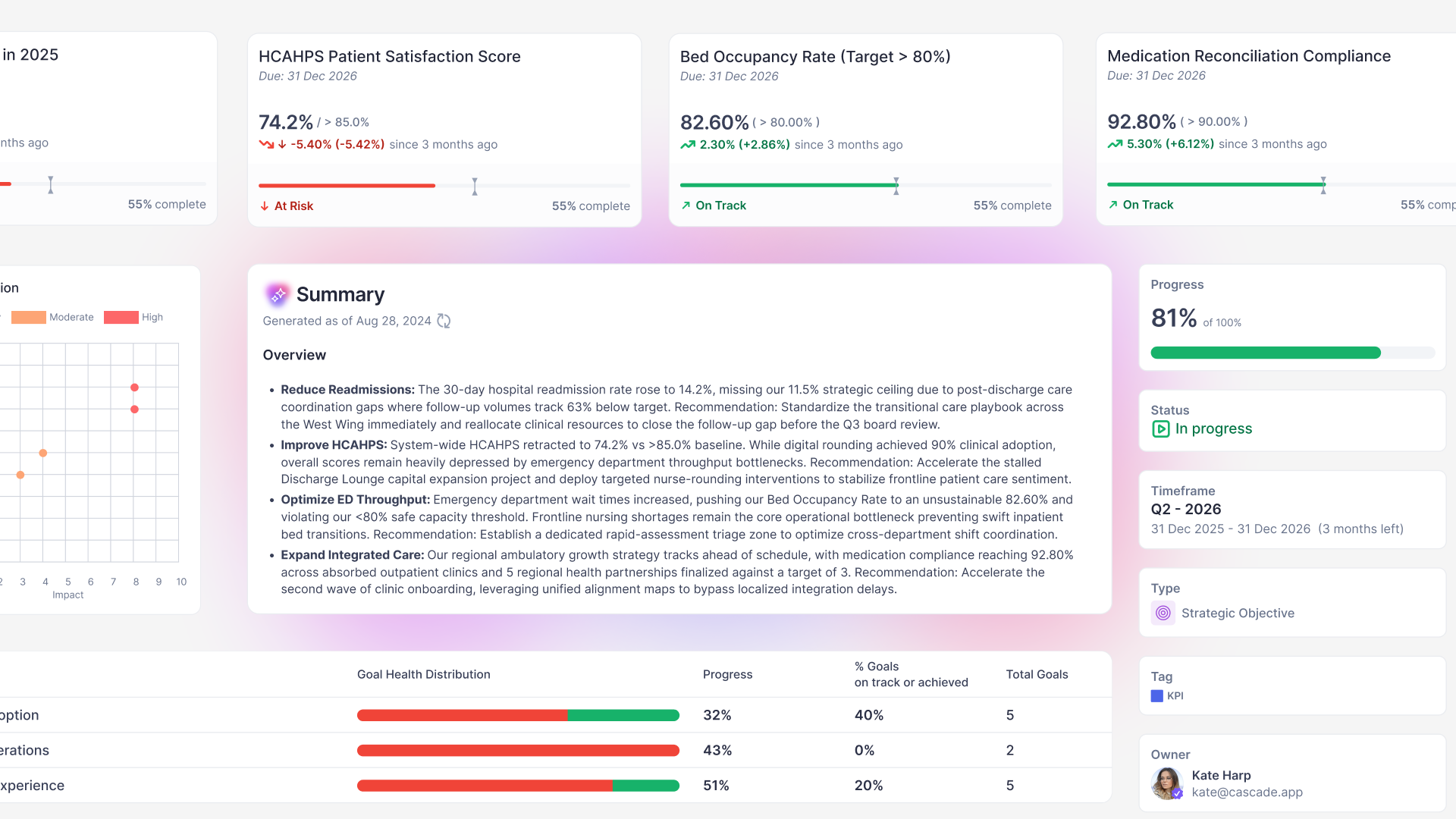
Cascade is the best strategy execution platform for healthcare organizations, hospitals and health systems that manage strategy across multiple facilities, regions, or entities.
Its healthcare roster runs deeper than any other platform here: UNC Health, University of Maryland Medical System, Emplify Health, Cone Health, Deaconess Health System, Franciscan Missionaries of Our Lady Health System, St. Jude Children's Research Hospital, and Perley Health all use it to connect enterprise goals to facility and department plans, with live operational data (think readmission rates, HCAHPS scores, throughput metrics) flowing into strategy instead of being retyped into slides.
→ For how health systems put all of this to work day to day (readmissions, HCAHPS, multi-site alignment, board reporting), see our healthcare strategy execution software use cases guide.
Pros
- Framework flexibility across entities. Runs Balanced Scorecard, OKRs, Hoshin Kanri, or fully custom frameworks, in any combination across facilities, service lines, and teams, all connected in one platform. For BSC organizations, Cascade is the platform the Balanced Scorecard Institute formally recommends, as its exclusive software partner.
- Alignment across the whole system. Alignment maps show how every facility, regional, and service line plan connects to enterprise strategy, vertically and horizontally, with AI-calculated alignment and health scores that reveal which facilities are drifting from enterprise goals before the quarterly review, not during it.
- Board-ready reporting without the prep. Cascade automates the reporting cadence health systems run on: it requests updates from teams before each committee cycle, generates AI executive summaries and agendas from live data, and exports board packages to PDF or PowerPoint in one click.
- AI-native platform. Cascade's AI runs on Tapestry, its in-house intelligence engine, which weaves quantitative data together with human context and matches it to strategic objectives. Leaders can interrogate live data in natural language ("Why are readmissions off-track at this facility?") and get synthesized answers drawn from every plan in the system.
- Updates captured automatically. Tapestry Connect ingests meeting transcripts, emails, and files to draft progress updates against the objectives in Cascade for owners to approve, so clinical and operational leaders keep strategy current without writing status reports.
- Healthcare-grade security and governance. Cascade is SOC 2 Type II compliant with AES-256 encryption, SSO, role-based access, audit logs, and US, EU, and AU hosting for data residency. Its AI is built in-house with zero training on customer data, and the platform works with operational and performance data rather than patient records, so it sits outside PHI workflows.
- Fits the existing stack. 500+ integrations connect the data a health system already runs on.
- Proven category leader. Over a decade in the strategy execution market, with a Leader position in G2's Strategic Planning and Execution category.
Cons
- English-only resources. All training materials, including videos, guides, and webinars, are available only in English, which can slow rollout for teams operating primarily in other languages.
- Built for multi-entity depth. The breadth of features that make Cascade powerful for health systems can be more than a single clinic running one plan needs.
Pricing
Free forever for up to 2 users; Essentials and Enterprise+ on request, with unlimited users since pricing isn't seat-based. For more information visit Cascade's pricing page.
Reviews
4.7/5 on G2 (251 reviews), Leader in the Strategic Planning and Execution category.
If you're ready to see how a health system runs its strategy on Cascade, book a demo and we'll walk you through it with healthcare examples.

2. WorkBoard
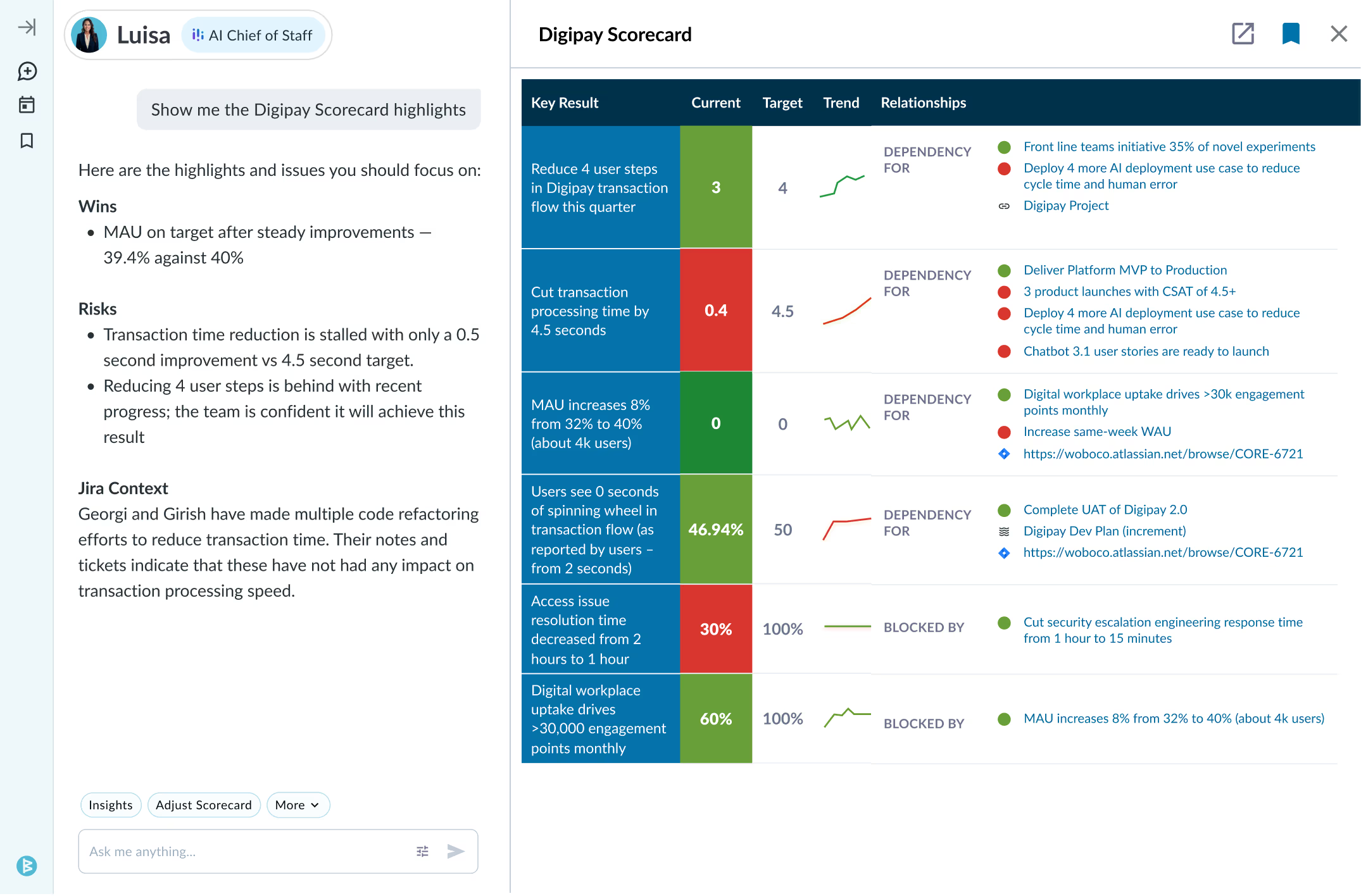
WorkBoard is an enterprise OKR platform, best for large organizations that run a disciplined, company-wide OKR program. Its healthcare presence sits at the edges of the industry: GHX in healthcare supply chain and AstraZeneca in pharma, with no hospitals or health systems among its featured customers. Its AI agents automate briefings and operating reviews, and a Microsoft partnership brings OKRs into Microsoft 365, which suits organizations standardized on that stack.
One thing to know if you're reading older comparison articles: WorkBoard acquired Quantive in May 2025, and Quantive customers have been migrated to the WorkBoard platform. Quantive (formerly Gtmhub) no longer exists as a standalone product.
Pros
- Enterprise OKR depth. Cascading objectives, dynamic scorecards, and operating cadence automation built for organizations with tens of thousands of employees.
- AI agents and Microsoft integration. Briefing and coaching agents plus a Copilot integration that brings OKRs into Microsoft 365.
- Enterprise-scale credibility. Boeing, Cisco, Mars, VMware, and AstraZeneca are named customers, proof it survives very large deployments.
Cons
- OKR-only. No support for Balanced Scorecard or the mixed frameworks most health systems actually run.
- No strategic planning layer. WorkBoard manages the execution of objectives but isn't built for the upstream work of strategy formulation, framework modeling, or long-range planning.
- Heavy rollout. Reviewers describe a significant learning curve, and the model assumes formal OKR coaching to succeed.
Pricing
Not published; quote-based.
Reviews
4.7/5 on G2 (103 reviews)
3. Envisio
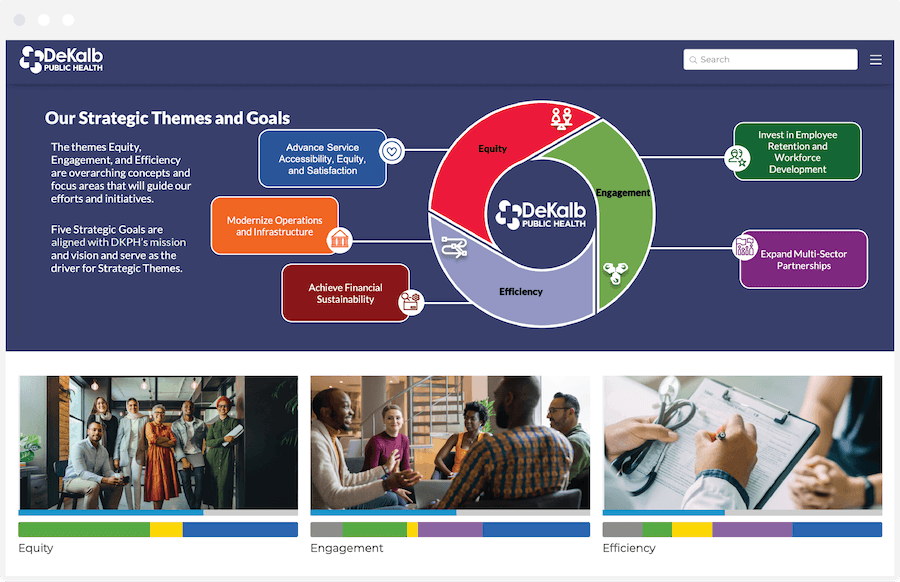
Envisio is a strategic planning and performance platform built exclusively for public sector and nonprofit organizations, best for public health agencies and community health organizations that need public transparency built in. Its healthcare customers reflect that lane: Maricopa County Public Health, DeKalb Public Health, VNA Home HealthCare, Middlesex Health, and NEOMED (Northeast Ohio Medical University), with Cedars Sinai the notable hospital-side exception. Most of its roster is local government; Envisio describes itself as the most widely used strategy management software in government.
Pros
- Built for public accountability. Public-facing dashboards and transparency reporting are core features, not add-ons.
- Ready-made benchmarking data. Its Polco Track integration provides performance measures, benchmarks, and KPIs purpose-built for local governments, drawn from verified sources like the US Census.
- Unlimited users and hands-on implementation. Pricing doesn't penalize broad adoption, and customers consistently praise the onboarding team.
Cons
- Very thin review base. 14 G2 reviews is minimal social proof for an enterprise decision.
- Cumbersome reporting and manual refreshes. Reviewers describe reporting and modifications as cumbersome, with a learning curve and manual data refreshes. For organizations that expect live operational data flowing into strategy, that's a meaningful gap.
- Public sector scope. Exclusively serves public sector and nonprofit organizations, and its healthcare customers are mostly public health agencies and community organizations rather than health systems.
Pricing
Quote-based, billed annually. Two tiers (single plan and multi-plan), both with unlimited users.
Reviews
4.7/5 on G2 (14 reviews)
4. ClearPoint Strategy
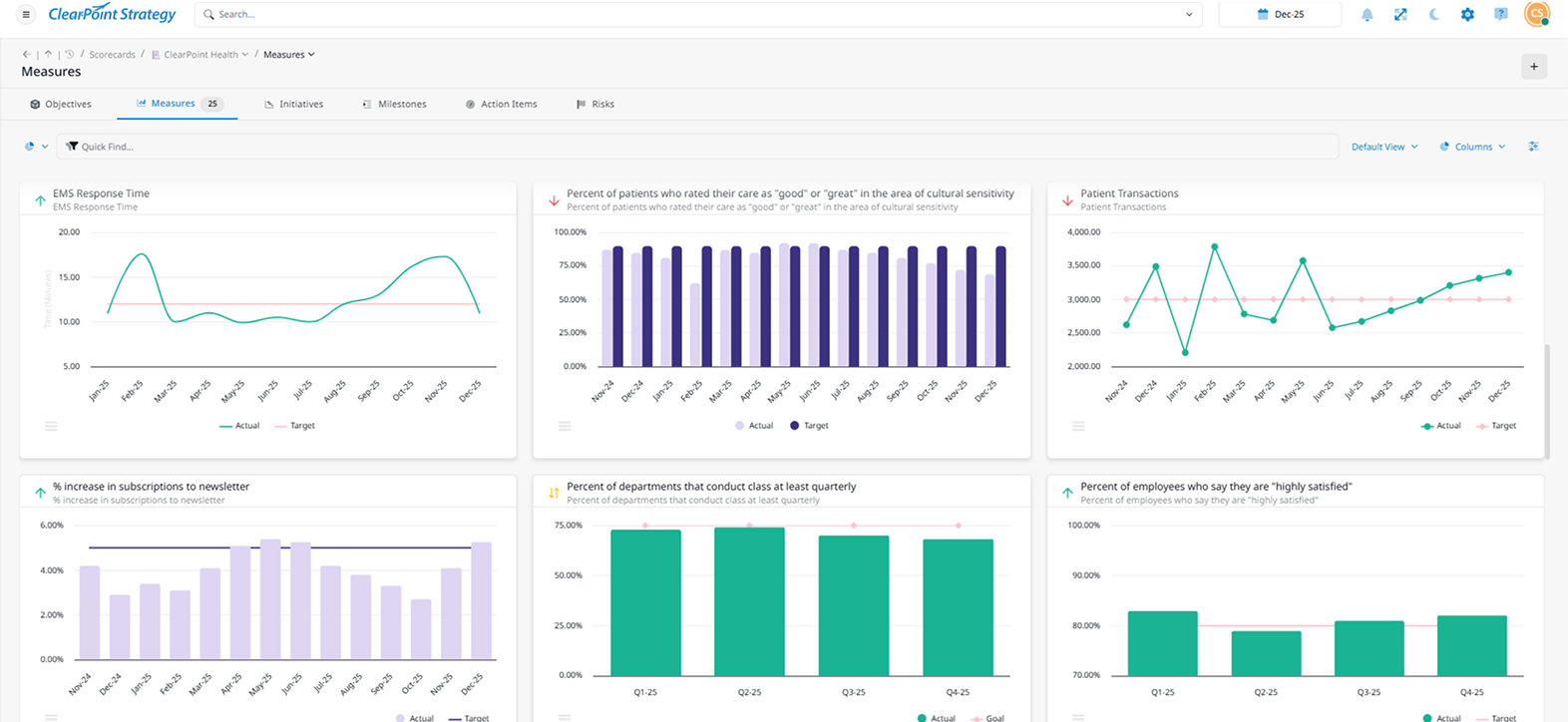
ClearPoint Strategy is balanced scorecard reporting software, best for healthcare organizations whose planning runs on BSC and whose biggest pain is producing board and committee reports. It started as a strategy reporting system and that remains its center of gravity, with AI assistants that now help draft plans and analysis. Its healthcare customers include Jefferson Health, Carilion Clinic, San Juan Regional Medical Center, Southern Ohio Medical Center, and Fox Chase Cancer Center (Temple Health), though much of its broader customer base is local government, where reporting requirements look similar.
Pros
- Reporting automation. Automates the full reporting motion, from collecting scorecard updates across departments to formatting them into board and committee packages, which is the work that consumes most of a strategy office's month.
- Scheduled report distribution. Reports and briefing books generate and send on a schedule to the people who need them, so nobody assembles the monthly package by hand or chases down the latest version before a board meeting.
- Highly rated support. Customers consistently praise its customer success team across review sites.
Cons
- Reporting-first architecture. Built around the monthly reporting cycle rather than live data and day-to-day execution.
- BSC specialist without the BSI endorsement. ClearPoint positions itself around the Balanced Scorecard, but the Balanced Scorecard Institute formally recommends Cascade as its exclusive software partner.
- Interface and formatting friction. Reviewers describe the Classic version as hard to find your way around, and report styling as inflexible.
Pricing
Not published; quote-based. Plans start at 10 users.
Reviews
4.6/5 on G2 (177 reviews)
5. AchieveIt
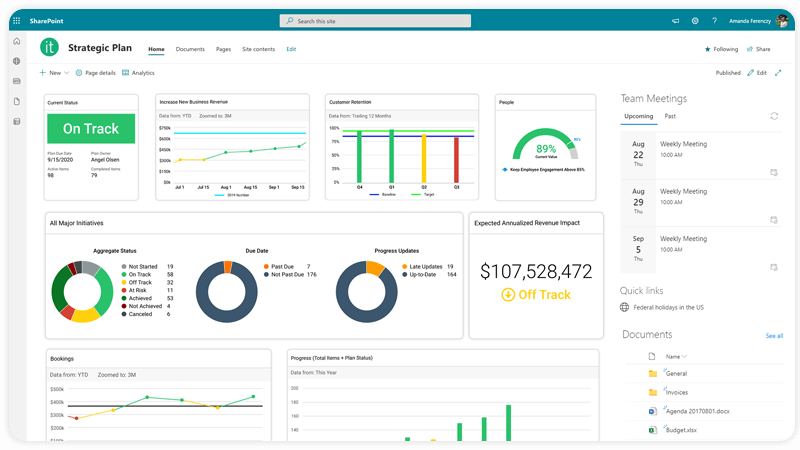
AchieveIt is a strategy execution software with healthcare roots: the company began in 2010 as a strategy consulting firm for hospitals and health systems before building the product. It's best for hospitals and academic medical centers that want hands-on vendor support through rollout. Its healthcare customers include UC Davis Health, Hackensack Meridian Health, OSF HealthCare, Texas Children's Hospital, CHI Health, Arkansas Children's, and CHRISTUS Health.
Pros
- Hands-on support. Its customer engagement team advises on plan structure using healthcare-specific practices.
- Automated update collection. Scheduled update requests and automated reports cut the status-chasing that eats leadership meetings.
- Embedded dashboards for public sharing. Widgets let organizations publish live dashboard data to websites, intranets, or SharePoint, which suits providers that report outcomes publicly.
Cons
- Manual update model. Progress largely arrives through people responding to update requests rather than live integrations with source data.
- Limited integrations. Reviewers cite a thinner integration catalog than platforms built around live data feeds, so for organizations with performance data spread across BI, finance, and operational systems, more of the connective work falls on people.
- No AI layer. AchieveIt automates update collection and report generation, but the platform doesn't advertise any AI capabilities such as assisted planning, natural language analysis, or drafted updates.
Pricing
Not published; quote-based.
Reviews
4.4/5 on G2 (199 reviews)
6. Spider Impact
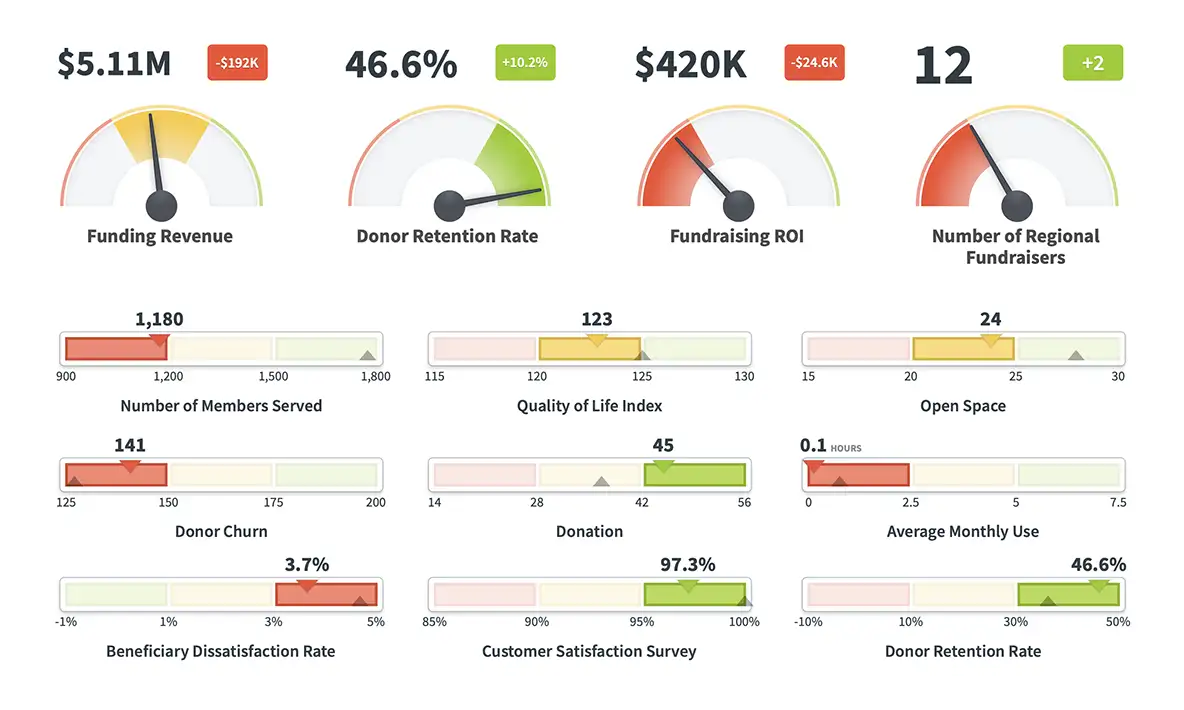
Spider Impact (from Spider Strategies) is a legacy balanced scorecard automation tool, best for small teams that want to digitize a traditional scorecard with dashboards and briefing books. Its main historical claim was that its QuickScore product was the software the Balanced Scorecard Institute formally recommended for over a decade; that recommendation now belongs to Cascade, which the Institute endorses as its exclusive software partner.
Pros
- Straightforward scorecard automation. Covers the classic balanced scorecard workflow properly: KPIs, strategy maps, dashboards, and briefing books that replace the quarterly PowerPoint, without the overhead of a larger platform.
- Lightweight by design. For a small team digitizing one scorecard, there's less to configure and administer than an enterprise platform.
- Deployment flexibility. Cloud or self-hosted, with a FedRAMP-authorized government edition.
Cons
- Scorecard-scoped. Built around KPI scorecarding rather than initiative execution: none of the update-collection workflows, context capture, or execution cadences of the platforms above.
- Minimal market validation. An unclaimed G2 profile with a single review is a lot of diligence for an enterprise buyer to do alone.
- No healthcare proof. Spider has a healthcare page, but doesn't name any healthcare customers or case studies.
Pricing
Not published; quote-based, tiered by users and features.
Reviews
5.0/5 on G2 (1 review, unclaimed profile). Listed last per our ranking rule for platforms with fewer than 10 reviews.
Other Tools Worth Knowing (OKR Platforms)
Two more tools come up in healthcare searches, and both are worth knowing about even though they belong to a different sub-category: dedicated OKR software. They're built for company-level goal tracking, not multi-entity health system strategy, so we haven't ranked them alongside the platforms above.
They can be a good fit for smaller healthcare organizations with a single plan, or for an individual department, clinic, or team that wants to run its own goals on OKRs without adopting an enterprise platform. If the whole organization already works in OKRs and nothing else, they're worth a look.
Mooncamp (4.8 on G2, 298 reviews) is a clean, well-liked OKR tool priced at €7 per user per month for Essential and €10 for Professional, billed annually, with a custom-priced Enterprise tier. Teams praise its simplicity and Microsoft Teams integration. Alongside OKRs, it covers check-ins, dashboards, and custom fields for shaping goals to how a team works.
Perdoo (4.4 on G2, 544 reviews) combines OKRs with KPIs and offers a free plan for up to 5 users, with Premium at $7.20 and Supreme at $8.80 per user per month billed annually, subject to volume discounts. Its KPI boards and roadmap views give teams a bit more structure around their OKRs than goal tracking alone.
How We Ranked These Tools
We ordered the platforms by their G2 rating and broke ties by review count, with one exception: anything with fewer than 10 reviews goes to the bottom of the list, because a 5.0 from a single review just isn't comparable to a 4.7 built on 251 of them. Pricing was checked against vendor sites and third-party sources in July 2026, and where a vendor doesn't publish pricing, we say so instead of guessing. Every healthcare customer named in this article comes from the vendor's own published case studies and customer pages.
FAQs
What is the best strategy execution software for hospitals and health systems?
Cascade is the best strategy execution software for hospitals and health systems, especially multi-entity systems that need to align facilities, regions, and service lines under one enterprise strategy while running different frameworks (Balanced Scorecard, OKRs, or custom). It's used by health systems including UNC Health, University of Maryland Medical System, Emplify Health, Cone Health, and Deaconess, and it's the platform formally recommended by the Balanced Scorecard Institute. AchieveIt and ClearPoint Strategy are the main healthcare-focused alternatives: AchieveIt for hands-on onboarding in hospitals, ClearPoint for balanced-scorecard board reporting.
What is the best strategy software for healthcare organizations?
The best strategy software for a healthcare organization depends on what kind of organization it is. Multi-hospital health systems are best served by Cascade. Public health agencies and community health organizations with transparency requirements should look at Envisio. Individual hospitals that want a high-touch, healthcare-savvy vendor should shortlist AchieveIt.
Are Strata, Sg2, Trilliant Health, or Synario strategy execution software?
No, Strata, Sg2, Trilliant Health, and Synario are not strategy execution software, though they are frequently confused with it. Strata and Synario are healthcare financial planning and modeling tools. Sg2 and Trilliant Health are market intelligence and analytics platforms. They inform strategy with forecasts, benchmarks, and market data; they don't manage the execution of strategic plans across an organization. Many health systems run one of these alongside a strategy execution platform like Cascade, feeding its outputs in as inputs to strategic decisions.
Is Cascade part of Quantive?
No, Cascade is not part of Quantive and never has been. Cascade (cascade.app) is an independent company, founded in 2014 and built around its own platform. Quantive (formerly Gtmhub) was a separate OKR software vendor that was acquired by WorkBoard in May 2025 and no longer exists as a standalone product. The two companies are unrelated.
Does strategy execution software handle patient data?
No, strategy execution software doesn't handle patient data, and it shouldn't. Patient records live in EHR systems like Epic and Oracle Health; strategy execution platforms like Cascade work with the aggregated operational and performance metrics derived from those systems, such as readmission rates, HCAHPS scores, staffing metrics, and financial and quality KPIs. They sit at the management layer, not in clinical workflows, so they don't store or process protected health information (PHI) and don't sit in HIPAA-covered data flows. Platform security still matters; Cascade, for example, is SOC 2 and ISO 27001 compliant.

.png)


