


TL;DR:
Cascade is the best strategy execution software for higher education. Universities run more concurrent plans than almost any organization their size: an institutional strategy, a plan for every college and faculty, and unit-level plans. Cascade connects all of them in one institutional view, so leadership can see how each faculty is tracking against institutional goals. Faculties can each work in their own framework (Balanced Scorecard, OKRs, or custom) and still roll up centrally. It's used by the University of Sydney, the University of Notre Dame, Parker University, UC Irvine, and Gallaudet, among many others. Each alternative fits a more specific case: AchieveIt if you want hands-on higher-ed onboarding, ClearPoint if board reporting on a balanced scorecard is the main job, Elate if you're running a cabinet's review rhythm, Envisio if you report progress publicly to your community, Spider Impact if your focus is automating a balanced scorecard, and WorkBoard if you run a strict enterprise OKR program.
Most universities don't struggle to write a strategic plan. They struggle to keep it alive once the semester starts and every faculty goes back to running its own show. That's an execution problem, and it's close to universal: Cascade's 2026 State of Strategy Report, based on 1,112 leaders worldwide, found only 26% of organizations have a centralized system for strategy and 81% of departments pull in different directions.
Higher education multiplies it, because a university isn't one organization running one plan but a federation of institutional, faculty, and unit plans, each on its own cycle. Colleges and faculties still have to align and report up to the institution, but without a shared system that roll-up happens manually, reconstructed for each board meeting or accreditation review instead of visible continuously.
Strategy execution software is the layer that runs the plan: it assigns owners, tracks KPIs and initiatives, and turns live progress into board-ready reporting, so a decentralized institution can see how each faculty is tracking against institutional goals without waiting for the next committee deck. The seven platforms below are the strongest options for higher education.
The 7 Best Strategy Execution Platforms for Higher Education
1. Cascade
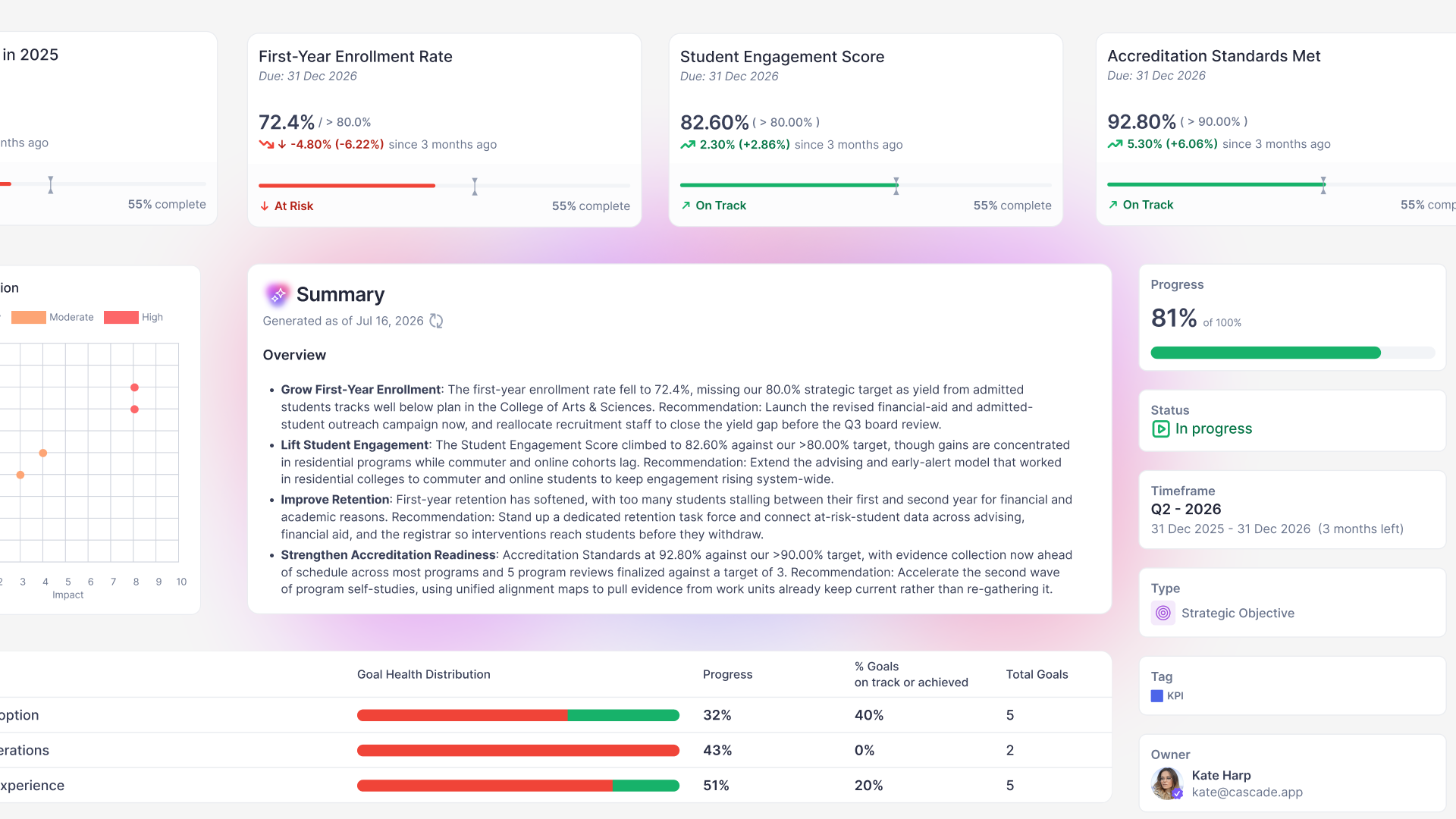
Cascade is the best strategy execution platform for universities and colleges that manage strategy across multiple faculties, schools, campuses, or regions. Its higher-ed roster runs across four continents: the University of Notre Dame, the University of Sydney, the University of Melbourne, UC Irvine, Loyola Marymount, Georgia State, the University of Vermont, Gallaudet, California State University Chico, the University of the Free State, the University of the District of Columbia, Universidad de los Andes, and the San Bernardino Community College District.
What makes it fit higher education specifically is the roll-up: a large university is a federation of colleges and units that each plan differently, and Cascade is built to let them keep their own frameworks while consolidating into one view leadership can actually act on. That's the problem decentralized institutions run into with tools built for a single, uniform plan.
Pros
- Any framework, one roll-up. One college can run OKRs, another a Balanced Scorecard, and a research office a custom model, all connected so every plan consolidates into a single institutional view. On the Balanced Scorecard side, Cascade is the Balanced Scorecard Institute's exclusive recommended software partner.
- Alignment across and up the institution. Alignment maps show how every faculty, campus, and unit plan connects up to the institutional strategy and across to other departments, with AI-calculated alignment scores that reveal how much a unit's work actually ladders up to institutional priorities, and where it diverges.
- AI-native, built on Tapestry. Cascade runs on Tapestry, its in-house intelligence engine, which powers the platform rather than sitting beside it. It weaves quantitative data together with the human context behind it to give leaders the full picture, then cuts through the noise to surface what's relevant to them and recommends where to act.
- AI that captures context automatically. Tapestry ingests meeting transcripts, emails, and files and drafts progress updates against the right objectives for owners to approve, so updates don't depend on people filling in forms. Leaders can also query live data in plain language and get answers pulled from every plan.
- Automated board reporting, plus accreditation evidence. Cascade collects updates ahead of each cycle and generates executive summaries, agendas, and board-ready exports. Initiatives can be tagged against accreditation requirements, building the evidence trail a review needs, while the learning-outcomes assessment itself stays in a dedicated tool.
- Integrations across the campus stack. More than 500 integrations connect the BI, data warehouse, and ERP systems a campus already runs on, including Power BI, Tableau, Snowflake, and SAP, so metrics flow into strategy instead of being re-keyed.
- Security and data governance. SOC 2 Type II and ISO 27001 certified and GDPR compliant, with AES-256 encryption, SSO, role-based access, audit logs, and US, EU, and Australia data residency. The AI is built in-house and never trains on customer data, and because Cascade works with performance metrics rather than student records, it stays outside FERPA-covered systems.
Cons
- Depth a single office may not need. The capabilities that make Cascade strong for a multi-faculty institution are more than a lone department running one plan requires.
- English-only enablement. Guides, videos, and webinars are in English, which can slow adoption for teams working mainly in another language.
Pricing
Free forever for up to 2 users. Essentials and Enterprise+ are quote-based, with unlimited users since pricing isn't seat-based. See Cascade's pricing page.
Reviews
4.7/5 on G2 (253 reviews), Leader in the Strategic Planning and Execution category.
In practice: Notre Dame's Mendoza College
Before Cascade, Mendoza's plan was real but hard to see: KPIs weren't consistently set, and the work lived across Google Sheets, documents, Monday.com, and Slack, so functional-unit, program, and College goals never lined up in one place. Ryan Retartha's team moved it all into Cascade, wired in live enrollment data from Slate, and set a monthly cadence with the dean. Despite a history of initiative fatigue from earlier rollouts, they reached 88% monthly active users and 72% engaged users, most people leaving real updates rather than just logging in.
→ Read the full Mendoza story here!
Want to see what this looks like for your institution? Book a demo and we'll walk through it with higher-ed examples, from a single faculty to a whole university.

2. WorkBoard
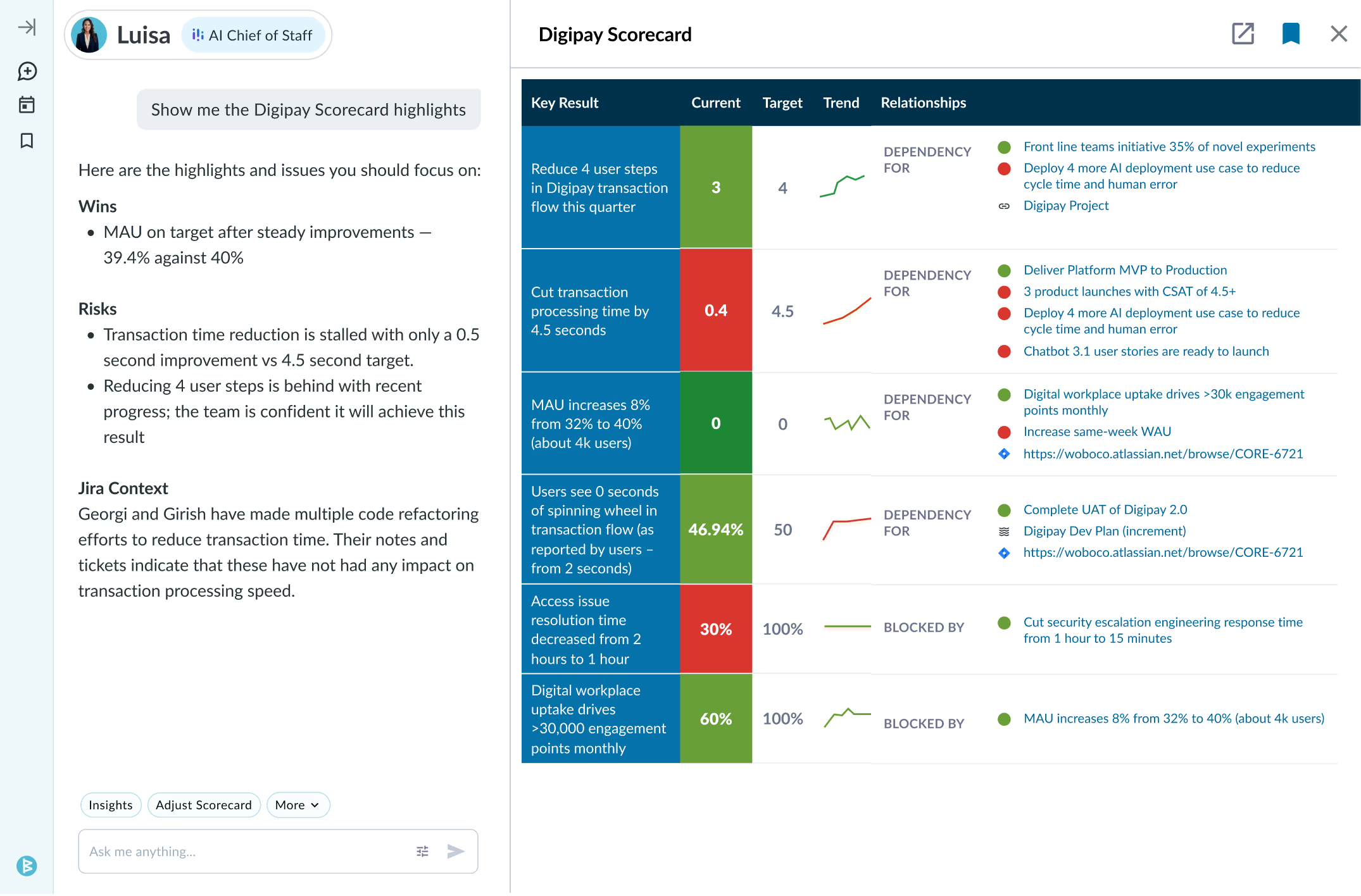
WorkBoard is built for enterprises that run everything on OKRs at scale. It's included here because it surfaces constantly in strategy execution searches, but its higher-ed fit is thin: its customer wall is enterprise (Boeing, Cisco, Mars), with no universities or colleges named. Its AI agents run the operating-review cadence for you, and because it plugs into Microsoft 365, it lands most easily at institutions already living in that ecosystem.
Pros
- OKR discipline for the operational side. For the parts of a university that run like a business, IT, advancement, facilities, student services, WorkBoard brings rigorous OKR cascading and automated operating reviews that keep large administrative teams in step.
- Scales to the largest institutions. Built for organizations with tens of thousands of people, so a big university system's headcount is never the constraint.
- Strong Microsoft 365 fit. For institutions standardized on Microsoft, OKRs and reviews live inside the tools staff already use.
Cons
- No higher-ed customer base. Its published roster is entirely enterprise, with no universities or colleges named.
- One framework only. OKR-only, with no Balanced Scorecard or mixed-model support for faculties that plan differently from central administration.
- Complex for new users. Reviewers consistently flag a steep learning curve and an interface new users find confusing, and note that the platform's own flexibility can disorient people, sometimes enough that its complexity becomes a reason teams don't engage with the OKR method at all.
Pricing
WorkBoard doesn't list prices publicly; pricing is quote-based.
Reviews
4.7/5 on G2 (103 reviews).
3. ClearPoint Strategy
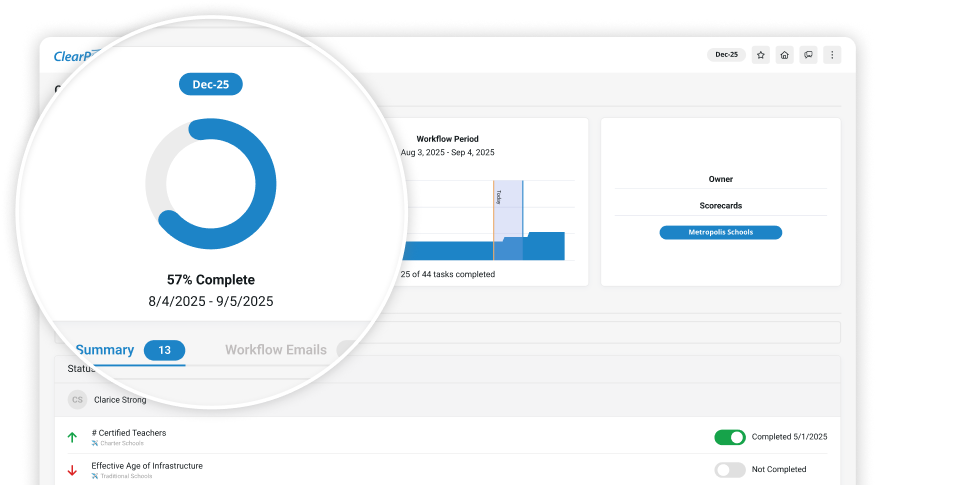
ClearPoint Strategy is a reporting-first platform for organizations that live in the Balanced Scorecard and measure success by how cleanly the board packet comes together. That reporting heritage is its strength. Its higher-ed footprint, though, is limited: it names only Metropolitan Community College and LSU's College of Engineering, and most of its customer base sits in local government rather than universities.
Pros
- The report writes itself. Instead of a strategy office rebuilding the board deck each cycle, ClearPoint pulls the latest scorecard data into a formatted packet on its own.
- Built for the reporting cadence. The board packets, committee updates, and accreditation summaries a university strategy office runs on a fixed rhythm are generated on schedule rather than assembled by hand.
- Support people rate highly. Its success team is a recurring bright spot in reviews.
Cons
- A careful rollout, not a switch you flip. Reviewers describe a steep learning curve for leadership teams and note that ClearPoint takes real discipline and a thoughtful rollout to pay off, closer to a change-management project than a tool you turn on.
- Rigid around one framework. ClearPoint is built tightly around the Balanced Scorecard, so institutions that want to mix frameworks, OKRs for some units, something custom for others, have less room to do it. And on the Balanced Scorecard itself, the Balanced Scorecard Institute recommends Cascade as its exclusive software partner.
- Customization limits and occasional glitches. Reviewers cite limited report customization, especially with text-based fields, and occasional glitches during reporting cycles.
Pricing
Pricing isn't published; quotes start at 10 users.
Reviews
4.6/5 on G2 (177 reviews).
4. AchieveIt
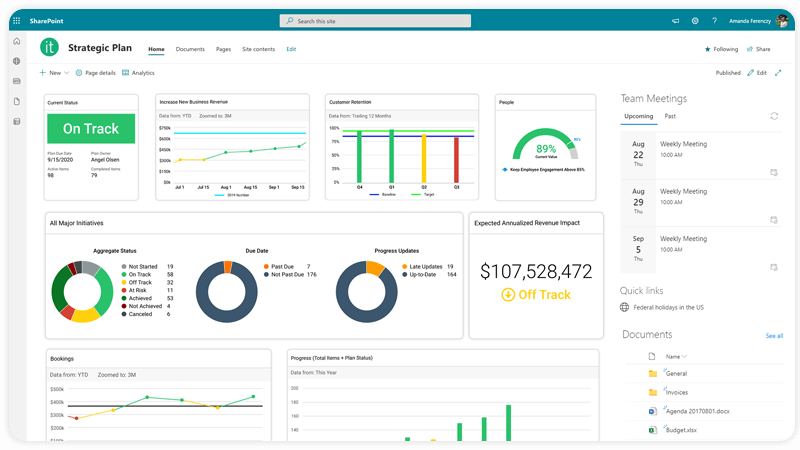
AchieveIt began in 2010 as a strategy consultancy before it became a software company, and that consulting DNA still defines it: the pitch is a vendor that works alongside your team through the messy early stages of a rollout rather than handing you a login and walking away. In higher ed it has a solid list of named institutions, including Tulane, Belmont, the University of Oklahoma, and Dalhousie.
Pros
- Consulting-led onboarding. Its origin as a consultancy means the people onboarding you have actually built strategic plans, not just configured software.
- Public reporting built in. Progress views publish to a public site or portal, which suits public universities that have to show outcomes to their board, system, or state.
- A real higher-ed customer list. AchieveIt names a fair number of universities and colleges, so a buyer can usually find a peer institution to reference-check against.
Cons
- Integration is a sore point. Reviewers repeatedly flag weak connections to the tools universities already run on, PowerBI and especially Excel, and say importing existing spreadsheet data into AchieveIt is harder than it should be.
- Dashboards that don't bend far. Reviewers describe the charts and reports as limited, with visualizations locked to date-based views and less flexibility than they'd get from other systems.
- No real AI layer. There's no assisted planning, no plain-language questioning of your data, and no auto-drafted updates, so the analysis, the reporting narrative, and the "what does this mean" work all stay manual while AI-native platforms automate them.
Pricing
No public pricing.
Reviews
4.4/5 on G2 (199 reviews).
5. Elate
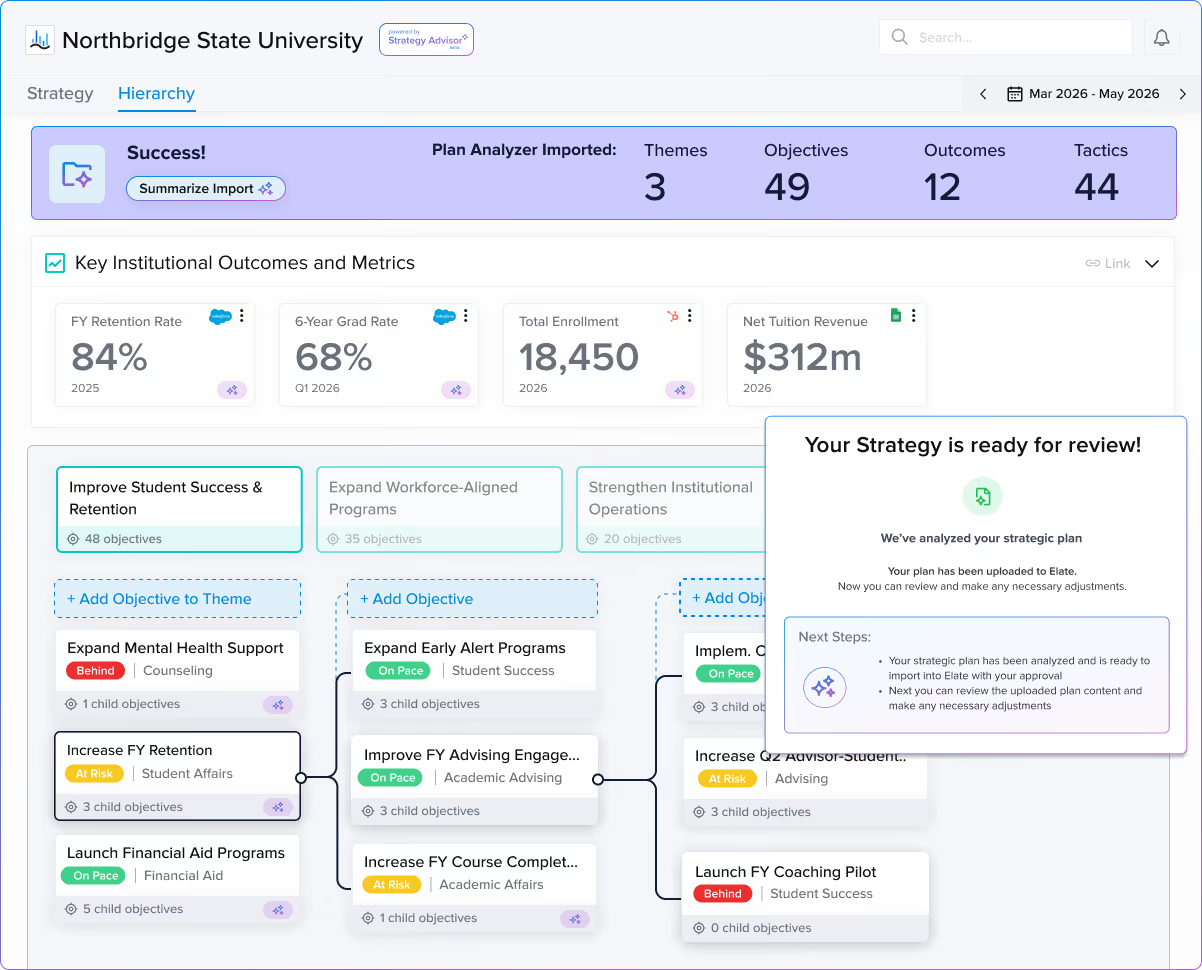
Elate is an AI-native strategy execution platform aimed at Chiefs of Staff, COOs, and strategy leaders, with higher education as one of several industries it serves alongside nonprofits, credit unions, and industrial. Founded in 2019, it's one of the younger tools here, focused on connecting priorities, execution, and reporting in one place. Its higher-ed customers include the University at Buffalo, UNC Pembroke, and Fairfield University.
Pros
- Clean, modern interface. Reviewers consistently single out how easy Elate is to look at and navigate, so a leadership team isn't fighting the tool to get a plan in front of the cabinet.
- Built around the leadership rhythm. The product is shaped around the cadence of a strategy or Chief-of-Staff office, setting priorities, assigning owners, running recurring reviews, which maps onto how a university cabinet runs its planning cycle.
- Automated, audience-tailored reporting. Elate generates reports tailored to different audiences and nudges owners for updates, cutting the manual chase before a leadership meeting.
Cons
- Not enough reviews to judge, and not recent. Only 13 G2 ratings, few of them recent, so there's limited independent feedback behind the score.
- Less framework flexibility. Reviewers ask for more customization, and the platform leans on set templates, so faculties that plan in different frameworks (OKRs in one unit, a scorecard in another) have less room to model that.
- Smaller integration and ecosystem footprint. Its integration catalog is narrower than the larger platforms', so institutions with sprawling BI, SIS, and finance stacks may find fewer ready-made connectors.
Pricing
Quote-only; Elate doesn't list prices publicly.
Reviews
4.8/5 on G2 (13 reviews).
6. Envisio
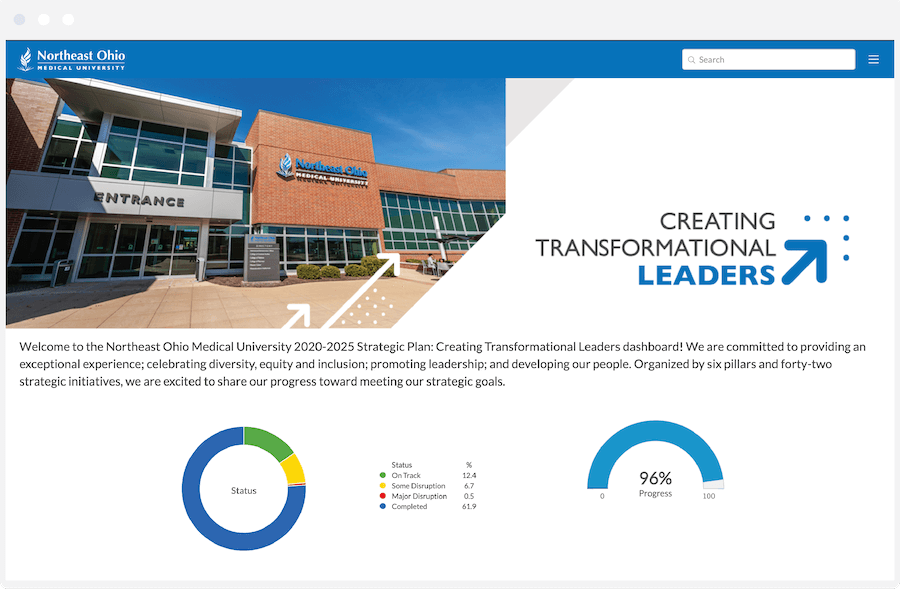
Envisio comes at strategy from the public-sector side: its whole product is designed around how government bodies and public institutions set goals and report progress to the people they answer to. For a public university or community college, that means transparency dashboards and community-facing reporting come built in rather than added on. Its education customers are real and varied, spanning Western Michigan University, Kennesaw State, Catawba College, and CalArts, though the bulk of its base is local government and school districts.
Pros
- Turnkey public dashboards. Progress dashboards can be published straight to a public website for boards, state systems, and the community to see, without a separate reporting build.
- Support people who show up. Reviewers repeatedly credit a human support team that jumps on calls and fixes bugs quickly, and the implementation help gets consistent praise.
- Unlimited users at no extra cost. Pricing isn't seat-based, so an institution can roll it out across every department and campus without the license count climbing.
Cons
- Not enough reviews to judge easily. With just 14 G2 ratings, there isn't much independent feedback to weigh, so a buyer has less to go on than with platforms that carry hundreds of reviews.
- No reporting on historical data. Reviewers note you can report on what's currently in the system but not on past states, so tracking how a metric or plan looked months ago takes a manual workaround.
- Report building isn't the most intuitive. Reviewers describe report and dashboard creation as clunky, with a learning curve for administrators and occasional glitches.
Pricing
Pricing is quote-based and billed annually, across two tiers.
Reviews
4.7/5 on G2 (14 reviews).
7. Spider Impact
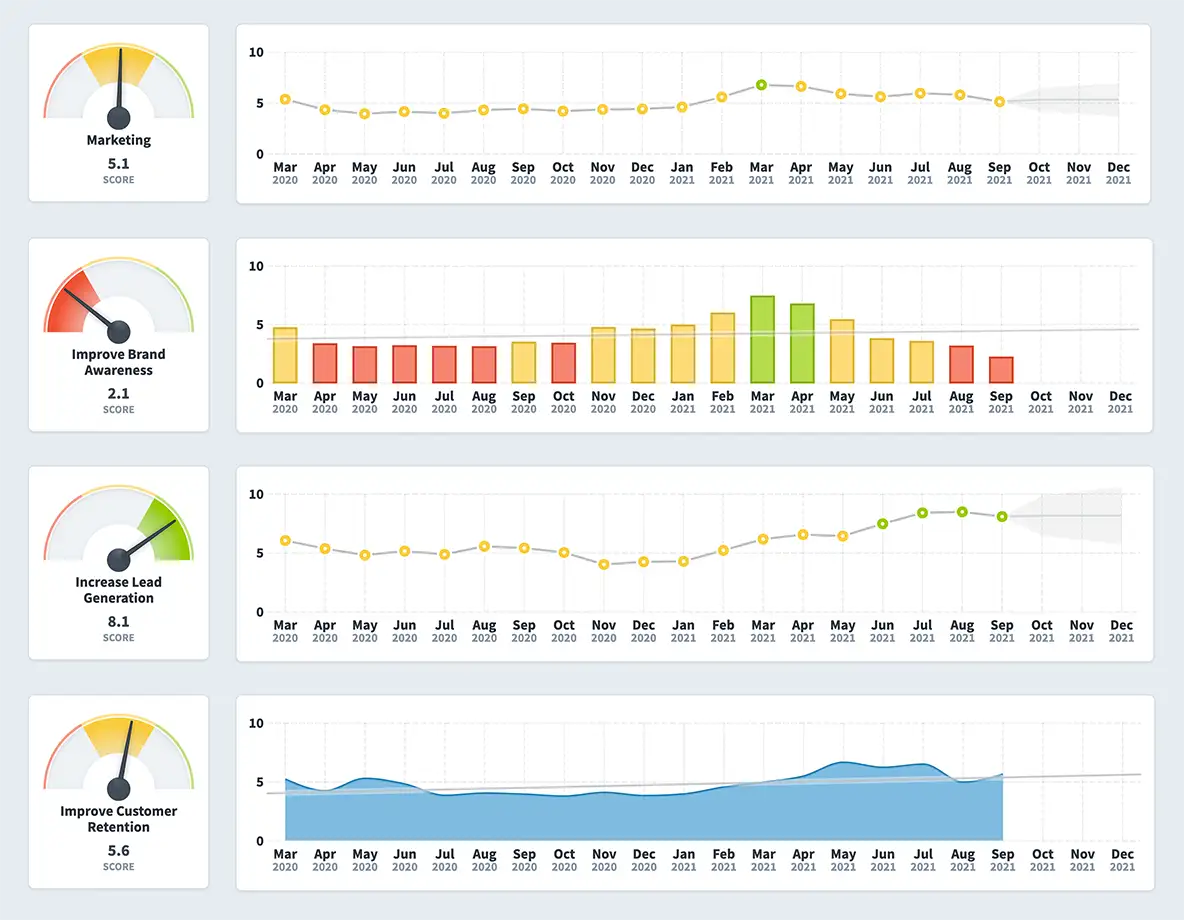
Spider Impact is a performance-management platform, made by Spider Strategies, built around the Balanced Scorecard, though it also supports OKRs, Hoshin Kanri, and plain KPI tracking. Its strength is turning a scorecard into live dashboards, strategy maps, and briefing books rather than static slides. In higher ed it points to a single named customer, the University of Sharjah, where it runs across a large multi-college deployment.
Pros
- Strong at the scorecard itself. For an institution whose planning genuinely runs on the Balanced Scorecard, Spider handles the full method, perspectives, strategy maps, KPI dashboards, and briefing books.
- Code-free dashboards and reports. Its charts, dashboards, and reports are configurable without technical work, so a strategy office can build and adjust views without leaning on IT.
- Flexible hosting. Available in the cloud or self-hosted, with a FedRAMP-authorized edition for government, which suits institutions with strict data-residency or public-sector requirements.
Cons
- Little social proof to go on. It names just one university customer and carries a single review on an unclaimed G2 profile, so there's very little independent evidence for a buyer to weigh.
- Scorecard-first by heritage. Its center of gravity is KPI and scorecard tracking rather than the initiative-execution workflows, automated update capture, and review cadences that the execution-focused platforms build around.
- No longer the Balanced Scorecard Institute's recommended software. Spider's QuickScore held that recommendation for over a decade; it now belongs to Cascade, which the Institute recognizes as its exclusive software partner.
Pricing
No public pricing; Spider quotes by user count and feature tier.
Reviews
5.0/5 on G2, but from a single review on an unclaimed profile. It sits last here under our under-10-reviews rule.
Other Tools Worth Knowing
Alongside the strategy execution platforms above, one adjacent category comes up often enough in higher ed to be worth placing: accreditation and assessment software. It doesn't replace the kind of platform ranked here, but it does a specific job that sits right next to institutional strategy.
Accreditation and assessment software
Accreditation and assessment software runs the academic side of institutional effectiveness: tying learning outcomes to evidence, mapping curricula, managing program review, and authoring the self-studies that regional accreditors like SACSCOC, MSCHE, and HLC require. For most institutions this work is non-negotiable, since accreditation is what protects federal funding and degree legitimacy, and it demands a level of evidence tracking that general strategy tools aren't built for.
It also sits at a different layer than strategy execution. An assessment platform holds the academic evidence; an execution platform like Cascade runs the institutional strategy above it and pulls accreditation progress into board and leadership reporting. The common setup is to pair the two, tagging accreditation work in the execution layer while the assessment engine does the outcomes work. Cascade handles that reporting side; it doesn't replace the assessment engine.
The two names you'll see most are Watermark and Weave.
Watermark is the larger, established player, used by more than 1,700 colleges and universities and partnered with a big share of SACSCOC, HLC, and Middle States institutions. It's really a suite of products (its Educational Impact Suite) spanning outcomes assessment, curriculum and catalog management, course evaluations, faculty activity reporting, and accreditation self-study, with integrations into SIS and LMS platforms like Canvas. That breadth is its strength and its tradeoff: powerful for a large institution that wants one vendor across many academic-effectiveness needs, but heavier to adopt if all you want is assessment and accreditation.
Weave takes the opposite approach. It's positioned as the lighter, more affordable option, built by higher-ed practitioners, with accreditation, assessment, curriculum mapping, program review, and strategic planning in a single tool priced without per-module add-ons. Used by a community it puts around 3,200 members, it tends to appeal to smaller institutions and individual programs that want core functionality and straightforward pricing over a broad product suite.
How We Ranked These Tools
We weighed each platform's G2 rating against how many reviews stand behind it, rather than sorting on the rating alone. A high score means more when it rests on a deep, credible base: a 4.4 across 199 reviews is stronger evidence than a 4.8 across 13 or a 5.0 from a single unclaimed profile, so a thin review base pulls a platform down even when its raw rating is high. At the far end of that principle, any platform with fewer than 10 reviews drops to the bottom regardless of score. This is why Cascade leads, it holds a top-tier rating on by far the largest review base, and has the deepest higher-ed roster, and why the sparsely-reviewed tools sit lower despite strong ratings.
We verified pricing against vendor sites in July 2026, and where a vendor keeps pricing private we say that rather than invent a number. Every university and college named here is drawn from the vendor's own case studies and customer pages.
A note on bias: Cascade produced this article. We've done our best to represent every competitor honestly, including where they're a better fit than we are, and we've cross-referenced our competitive knowledge against public reviews and vendor pages.
FAQs
What's the best strategy software for higher education?
Cascade is the strongest strategy software for higher education institutions focused on executing their plan, especially large decentralized universities where each faculty plans in its own framework (Balanced Scorecard, OKRs, or custom) but everything still needs to roll up into one institutional view. It's used by the University of Notre Dame, the University of Sydney, and UC Irvine, and it's the platform the Balanced Scorecard Institute formally recommends. Established alternatives include AchieveIt for hands-on onboarding, ClearPoint for board reporting, Elate for cabinet operating cadence, and Envisio for public institutions. If your priority is accreditation and learning-outcomes assessment rather than executing the plan, purpose-built tools like Watermark or Weave belong on the list too, and many institutions run one alongside an execution platform.
What's the difference between strategic planning and strategy execution in higher education?
Strategic planning is the work of setting the university's direction, writing the plan and defining priorities and goals, while strategy execution is the work of delivering it, assigning owners, tracking KPIs and initiatives, and reporting progress to leadership and boards. The gap between the two is where most institutions struggle: the plan gets written, then stalls once faculties go back to their own priorities. Most modern platforms, Cascade included, support both, so the real question when choosing software is how well it handles execution and roll-up across a decentralized institution, since that's the harder part.
What's the difference between strategy execution software and a project management tool like Asana or Smartsheet?
Strategy execution software manages the institution's strategic plan, while project management tools like Asana and Smartsheet manage the tasks underneath it. Execution platforms like Cascade track strategic objectives, KPIs, ownership, and progress against institutional goals, then roll it all up into board and leadership reporting. Project management tools organize the day-to-day work (tasks, deadlines, assignments) but don't model strategy, connect faculty plans to institutional goals, or produce governance-ready reporting, so a university using one for strategy has to build and maintain that structure by hand. Many institutions run both, using an execution platform for the strategy layer and a project tool for task delivery, and connect them through integrations.
How is strategy execution software different from financial planning tools like OneStream or Workday Adaptive?
Financial planning tools, often called corporate or enterprise performance management (CPM/EPM), model the money: multi-year budgeting, financial consolidation, and scenario planning for things like enrollment declines, tuition changes, and capital projects. Strategy execution software runs the plan itself, goal ownership, KPI tracking, and initiative progress across faculties, then reports it to leadership and boards. There's some overlap, since several execution platforms can pull in financial data and track budget-linked metrics, but they don't do deep general-ledger consolidation, and finance tools don't run initiative execution across an institution. OneStream is the heavier, consolidation-strong option for large institutions wanting close, planning, and reporting in one system; Workday Adaptive is planning-and-forecasting focused and the natural fit for institutions already on Workday for finance and HR. Institutions that need deep versions of both typically connect a finance platform to an execution platform like Cascade.
Is Cascade part of Quantive?
No. Cascade (cascade.app) is an independent company founded in 2014 and built around its own platform. Quantive (formerly Gtmhub) was a separate OKR vendor acquired by WorkBoard in May 2025; it no longer exists as a standalone product. The two are unrelated, so older comparison articles that describe Cascade as "part of Quantive" are incorrect.


.png)


